 Wine Chronicles
Talkin bout a (wine) revolution
Posted on December 9, 2017

Book Review by Panos Kakaviatos
9 December 2017
What’s in a wine glass? These days: more than just white, red, rosé, sparkling or still. There’s also organic, biodynamic, natural, orange – and more.
Not too long ago, such terms were not part of wine parlance, but some people today, even in the wine trade, grapple with and even fret over many of these terms, which can leave enthusiastic wine consumers bewildered.
Does a “natural wine” make other wines “non-natural”? Are orange wines made from oranges? Do you have to dance to the light of the full moon to make biodynamic wine? And how different are biodynamic and organic wines from one another? And who determines them as such? Should we care?
Of course we should.
Just as food lovers pay attention to the quality of what is on their plate – Steak from an organic butcher? Carrots free of herbicides and pesticides? – why should wine lovers not seek out wines made as carefully as we want our food to be?
This is the wine revolution going on today: a reaction to overproduction and excessive yields of wine to sell as much as possible, without paying heed to quality potential, with pesticide- and herbicide-soaked vines and vineyards that in the past (and today, in many parts of the world) deaden soils and curtail the true potential of terroir-driven wines.
The revolution includes cleaner winemaking in the vat room, calls for lower uses (or no uses) of sulfur, and, if not dancing to the light of the moon, then taking into account lunar cycles in winemaking, to take but a few examples.
Skeptics and cynics – sometimes with justification – scoff at least at parts of this movement for everything “holistic” and “natural” as yet more marketing ploys to ply plonk. Of course savvy marketing behind this revolution exists… and caveat emptor always applies.
But a splendid new book – just in time for holiday wining and dining (and shopping) – finally brings readers a user-friendly approach to this revolution. Read More
Gevrey-Chambertin 2016
Posted on November 27, 2017

Looks to be quite good. Savvy buyers should seek village level wines.
By Panos Kakaviatos for wine-chronicles.com
27 November 2017
Based on a 16 November tasting of village, premiers and grands crus, 2016 appears to be darn good for Gevrey-Chambertin. Many thanks to Fabienne Nicot for the kind invitation to taste so many wines from this vintage at the Caveau Espace Chambertin, and to the vintners who offered their bottles to taste. The name of the tasting is Le Roi Chambertin.

Le Roi Chambertin: a horizontal of many village, premiers crus and grands crus from Gevrey Chambertin, vintage 2016
The vintage is remembered generally in Burgundy for its low crop – at least 20 per cent less than 2015 – and much of the blame comes from a particularly severe frost, as well as hail and mildew in some locations.
Gevrey Chambertin was not as badly affected by the frost as some other regions had been. And what made the vintage work were sunny months in July, August and September, with just a bit of rain at the right times to freshen berries that had to put up with sometimes excessive summer heat.
Due to variable frost damage earlier in the year, yields vary according to vineyard and producer, but the overall sense for Gevrey Chambertin is that of fine ripeness, with little sense of “over maturity”. The fine summer, quite hot at times, did not define the vintage as much as the heat of 2015 did, according to many tasters.
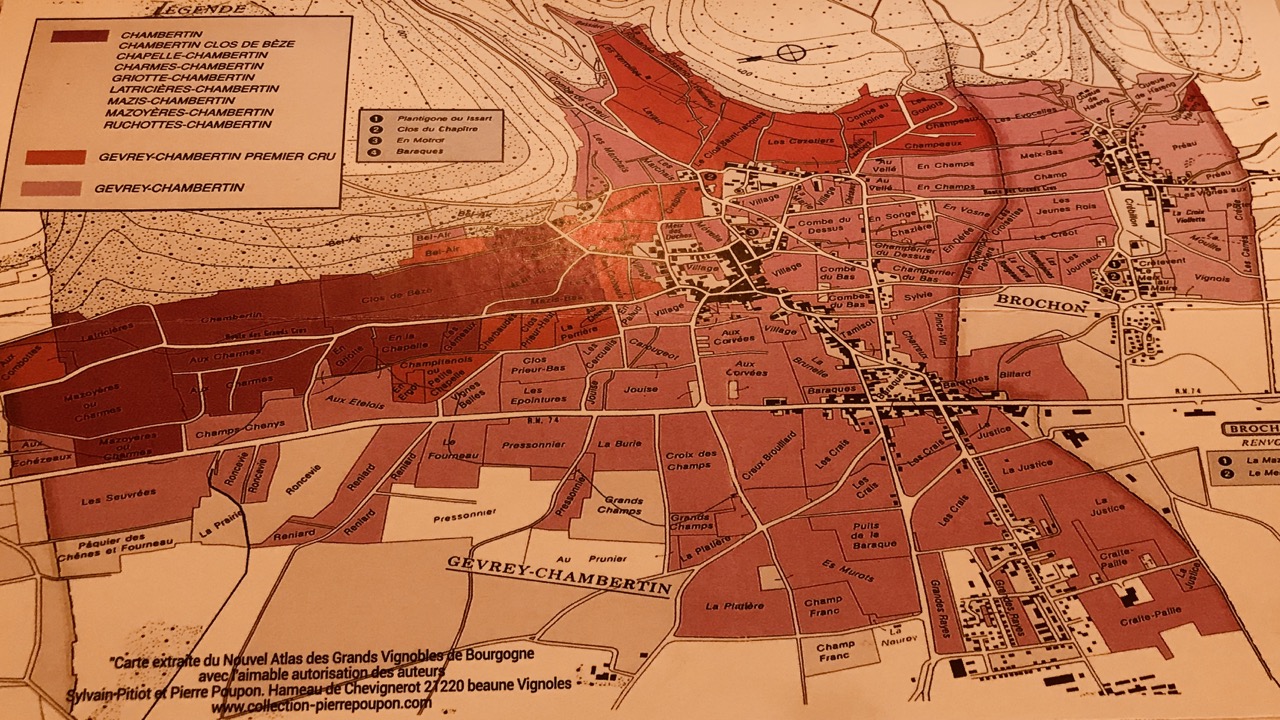
Map of Gevrey-Chambertin …
Gevrey-Chambertin in brief
As most readers know, Gevrey-Chambertin lies alongside the Route des Grands Crus at the northern end of the Côte which runs from North to South between the Combes of Lavaux at one end and Morey-Saint-Denis at the other.
For travellers coming from Dijon, Gevrey-Chambertin is where Bourgogne’s Elysian Fields begin. At the entrance to the hollowed hill of Lavaux, a château, once a property of the monks of Cluny, resembles a fortified wine-cellar. Gevrey-Chambertin, which dates back to an appellation from 1936, forms a kind of guard of honour to a set of fabulous grands crus whose crown jewels are Chambertin and Clos de Bèze. Read More
“Bourgogne Côte d’Or”
Posted on November 25, 2017

A brand new premium regional Burgundy
By Panos Kakaviatos for wine-chronicles.com
25 November 2017
Much of this text was published in Wine Business International yesterday, Friday November 24.
I recall hearing about a new level of regional Bourgogne wine, already a few years back at a press conference held in Beaune. It was supposed to represent the best of regional Burgundy, with grapes used only from Côte d’Or vineyards. It seemed to be taking a long while to get French appellation authority approval, but here is it.
The Bourgogne Wine Council announced this month a new premium level Burgundy regional wine made from only Pinot Noir or Chardonnay grown in Côte d’Or vineyards.
As the 14th regional Bourgogne AOC, Bourgogne Côte d’Or represents the top end of the regional appellations, explained Pierre Gernelle, general manager of the union of Burgundy negociant houses and producers.
“As we see Burgundy regional appellation wines getting more attention in the marketplace, we want to provide a better promise of terroir, because we are in Burgundy,” he explained. Check out my video interview with Pierre below.
In addition to the requirement that only Pinot Noir and Chardonnay is used from villages stretching across the Côte de Beaune and Côte de Nuits, Bourgogne Côte d’Or will have stricter plantation density requirements, set at a minimum of 9,000 plants per hectare, compared to a minimum of 5,000 plants per hectare for the other Bourgogne regional appellations. Production potential is estimated at 1,000 hectares, with about two-thirds red and one-third white.
Consumers will benefit from a more specific teroir-driven Bourgogne, explained Alberic Bichot of of Maison Albert Bichot. “If you have a Bourgogne that is near Pommard, that will be better than one that comes from Macon,” he explained. Read More
First impressions of Bourgogne 2017
Posted on November 19, 2017

Early impressions: a bit too low acidity for some whites, better overall from reds
By Panos Kakaviatos for wine-chronicles.com
19 November 2017
Based on a tasting of wines – to be sold today at auction at the famous Hospices de Beaune – the 2017 vintage seems to reflect a vintage where whites were more challenging and reds fairly bright and up front. Indeed, Ludivine Griveau, director of winemaking for the Hospices de Beaune domain, explained that some people were tempted to make lots of wine risking a bit of dilution.

Great to taste – as ever at the Hospices – with the great Michael Apstein of Wine Review Online
Her team at the Hospices, by way of some green harvesting among other methods, kept yields low to maintain high concentration. Based on tasting these “prenatal” wines (the reds had not undergone malolactic fermentation, neither the whites except for the Batard Montrachet), the reds are pretty good if a touch uneven. As for the whites, some showed flabby characteristics, reflecting a concern for lower than average acidities. “It was important to harvest earlier, to maintain freshness,” said Griveau in the video, below. But lovely whites came through as well, from a very tasty Pouilly Fuissé to an elegant and bright Meursault Genevrières.
My tasting notes below – as usual if bold, I liked in particular. If red and bold, even more. If underlined, too, potential wine nirvana. It is hard to talk about nirvanas when tasting such young wines, however, so I stress “potential” wine nirvana… Read More
Charles Aznavour to preside over Hospices de Beaune
Posted on November 13, 2017

2017 proves “cruising speed vintage”
13 November 2017
By Panos Kakaviatos for wine-chronicles, with text culled from Bourgogne Wine Council press releases
In just a few days, world famous crooner and UN goodwill ambassador Charles Aznavour will join Agnès b., Julie Depardieu and Marc-Olivier Fogiel as presidents of the 157th Hospices de Beaune auction, which takes place this year on Sunday 19 November. His cause this year will be Alzheimer’s disease. The other presidents will raise money for other worthy causes.
And I’ll be there again to track results, which often reflect worldwide demand for a given vintage.
Before we get into the auction, how it works and why such famous people like Aznavour and Julie Depardieu are involved, let’s briefly take a look at the 2017 harvest…
About the harvest
I did not visit Bourgogne (the French word for Burgundy) this year for the harvest, but according to reports, the mood of vintners this year is one of both “relief and joy,” because 2017 marks a return to “cruising speed” after a series of vintages that had suffered significant weather whims, the 2016 in particular.
Indeed, this year’s auction reflects a healthier crop: 787 pièces (a Bourgogne barrel containing 228 liters) will go under the hammer this coming Sunday as opposed to only buy 596 in 2016
Mild weather at the end of winter into early spring led to an early and fast bud-burst. In mid-April, it took a few days for vines to produce their first covering of leaves, some 7-10 days ahead of the average over 1994-2016. From then on, vines grew at “breakneck speed,” thanks to the weather which offered sunshine, heat, and the odd welcome spell of rain. There was little disease, and spraying was reduced across the entire campaign, according to the Bourgogne Wine Council.
By mid-June, the plants were flowering, and the first fruit appeared soon after. The suggestion that this would be an early vintage was confirmed – still 7-10 days ahead of the average over 1994- 2016 – and the idea that harvesting would begin at the very start of September seemed increasingly likely.
Recent Comments