 Wine Chronicles
Bordeaux 2015 from bottle, part 3
Posted on January 30, 2018

Better whites than expected from the Graves region
By Panos Kakaviatos for wine-chronicles.com
UPDATED 30 January 2018
It is always fun to review the wines of the Graves in Bordeaux because they are known just as much for whites as they are (these days) for reds. Furthermore, red Graves – dominated for the most part by Cabernet Sauvignon – tend to be more supple than the Left Bank wines of the Médoc further north. And of course, the Graves region is the oldest of Bordeaux: wine was being made there when the Médoc was still a swamp.
Tasting recently bottled 2015 AOC Graves wines – primarily from Pessac-Léognan – I was thinking that the whites would not be as good as the reds, given the nature of the vintage.
But based on wines tasted at the UGCB, on the first stop in Washington D.C. of their annual multi city U.S. whistle stop tour (and, in this update, including wines tasted in New York City also in January 2018), the mixed bag was not so much whites being not as good as reds, but somewhat varying quality throughout.
Don’t get me wrong. Most UGCB members are making darn good wines these days – they don’t call it the Union of Grands Crus for nothing – and in a high quality vintage like 2015, one expects (very) good things. And, yes, broadly speaking, the reds were better, but I was surprised how some whites performed as well as they did… and how some reds did not measure up to vintage hype.
It is clear that making white wine was more challenging in 2015, as Olivier Bernard, owner of Domaine de Chevalier, explains in the video below.
Chinese food and aged Bordeaux?
Posted on January 29, 2018

It works
By Panos Kakaviatos for wine-chronicles.com
29 January 2018
I recently met with friends at a Chinese restaurant in Bethesda, Maryland where we enjoyed 1970 Palmer and 1975 Trotanoy among other treasures with Chinese food.
“Heresy” you say?
The crazy spice and umami intensity often associated with Chinese food obliterates the soft finesse of a nearly 50-year-old Margaux from a high yield vintage with no second wine, right?
Well, no.
It depends on the restaurant and the level of spice.
The restaurant we enjoyed over a long lunch is Q by Peter Chang.
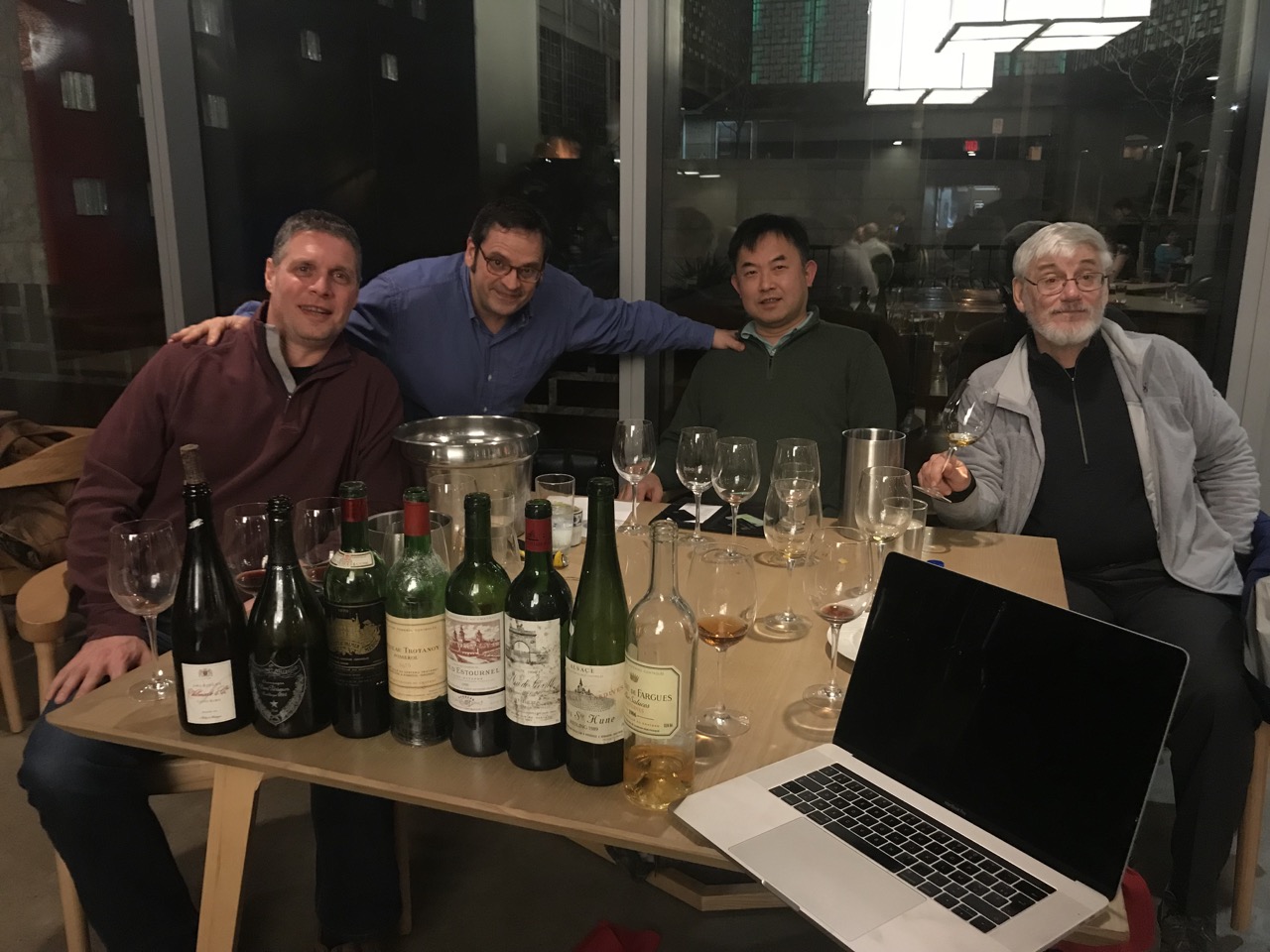
From left to right: Assaf Pinchas, myself, Kevin Shin and Chris Bublitz
Peter Chang is an award winning chef specializing in Szechuan cuisine who has cooked for restaurants throughout cities in the American southeast and the Washington D.C. area. Born in Hubei Province and trained in China, Chang cooked a meal for former Chinese president Hu Jintao. He moved to the United States to work as the chef at the Chinese Embassy in Washington, D.C. Over the past few years, Chang has inspired a group of fans in Internet discussion boards, such as DonRockwell.com and Chowhound.
Q , which stands for Qijian, means “flagship” in Chinese.
One could say that his Peking Duck at Q is the best in the competitive Washington D.C. food market. The duckmeat we enjoyed was at once savory and delectable, and of a fine texture. And not spicy: a perfect foil for fine Bordeaux. Selected from top quality breeders, the ducks are prepared through a five-step procedure resulting in fatty richness but never greasy. Home-made pancakes, soft and smooth, accompanied by scallions and sweet bean sauce add to the tasting experience although I only used the sauce sparingly.
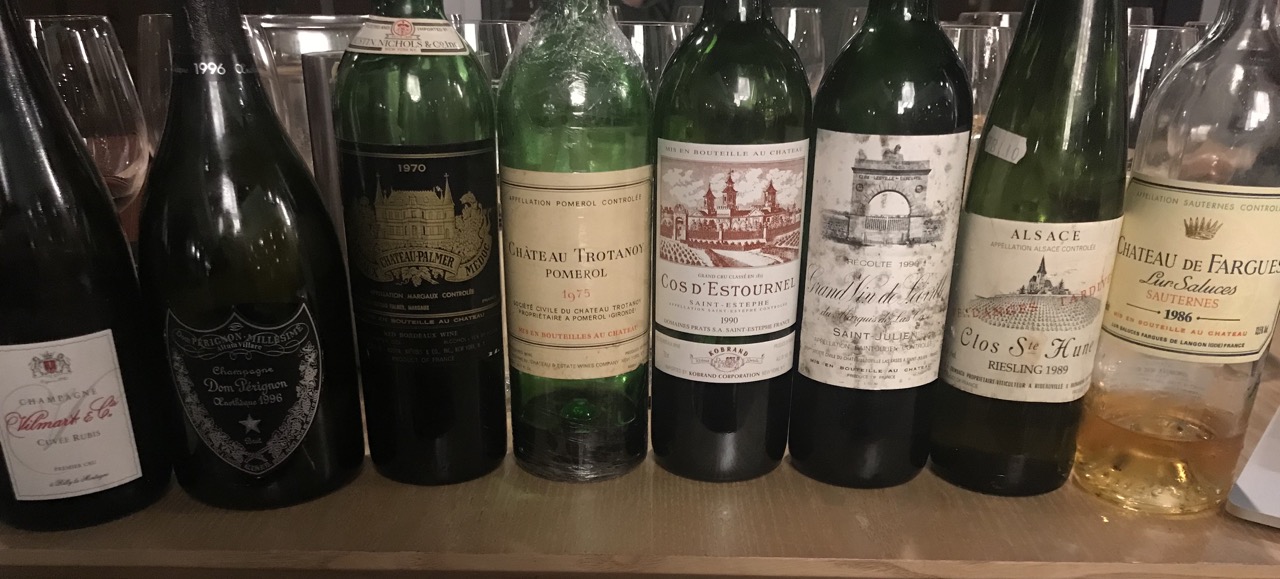
With fine Chinese food? Of course!
When is the right time for a wine?
Posted on January 28, 2018

By Panos Kakaviatos for wine-chronicles.com
28 January 2018
I suppose the short answer is “anytime” but that would be too facile.
January has been always a great month for me to hook up with wine loving friends, old and new, in Washington D.C. during the holiday season, when I take an extended holiday break from my work in France.
In this case we celebrated the birthday of friend Amy Ray, as well as the New Year 2018.
We enjoyed many Burgundies. I was very much looking forward to trying the Georges Roumier Bonnes Mares, but being a 2009, it proved indeed too young to properly enjoy. Another 2009, a Vosne Romanée, however (see tasting notes below) proved downright delicious and ready for wine drinking business.
As for a 1988 grand cru white from Burgundy, one may think that we were risking the timing, given evidence of too many prematurely oxidized whites from Burgundy. And yet, as it can be with wine drinking, you need some luck with the timing, as the 1988 proved to be one of the very best wines from this evening!
It was interesting to note how two Pommards of high reputation were comparatively rustic. We ended things with a most marvelous Alsatian Vendanges Tardives from the 2001 vintage. Everyone thinks of Sauternes for late harvest wines from France, but Alsace also excelled in that vintage for these types of “sweet” wines.
As for the two starting Champagnes, the answer is that it is always time to drink Champagne! Although we did not have any Bollinger, it is so true what Lilly Bollinger once said about the famous bubbly:
As usual, wines in bold, I liked in particular. When red and bold, even more. If underlined, too, a kind of wine nirvana.
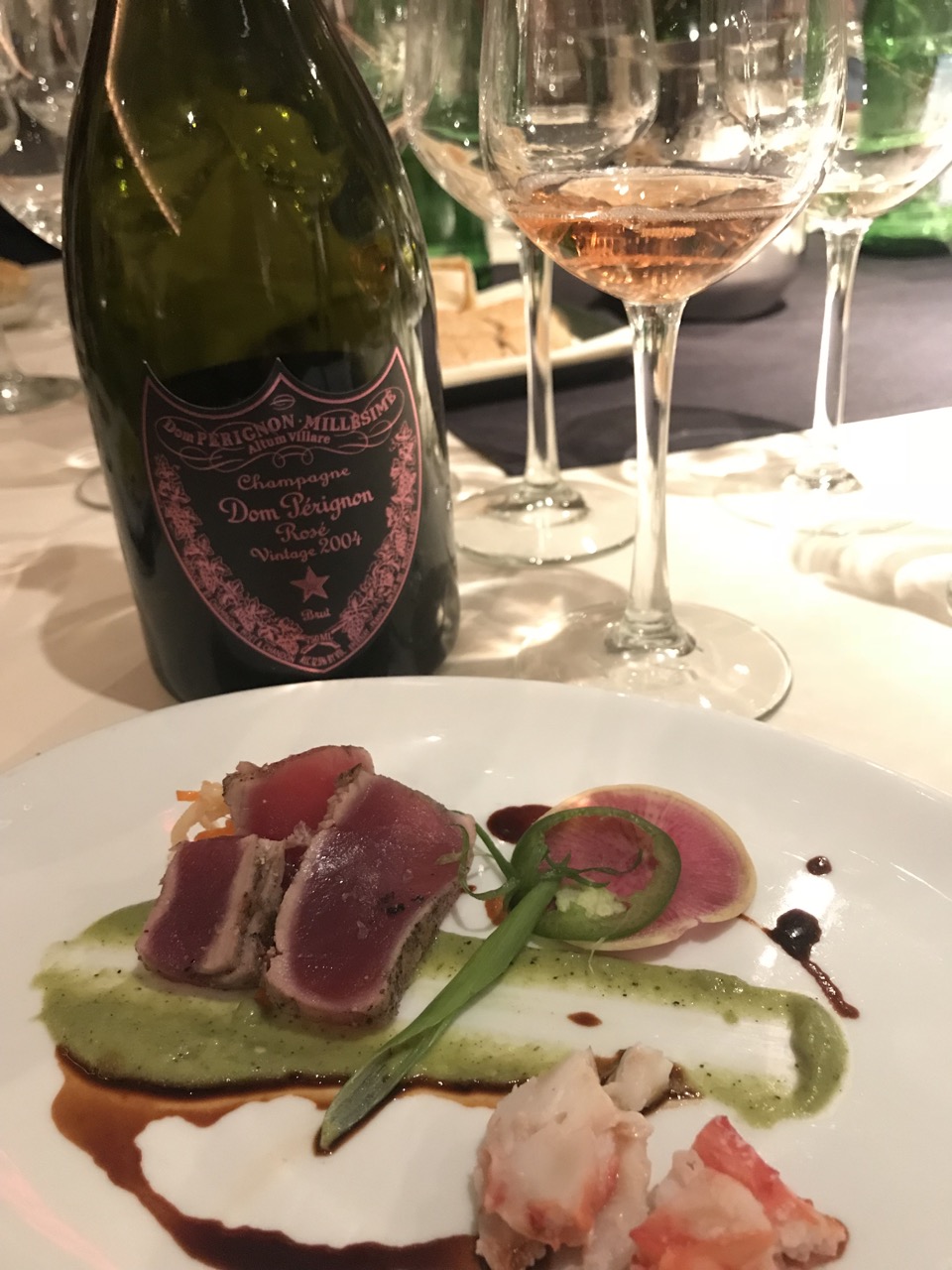
Color coordinated, and so was the flavor!
Madeira Magic
Posted on January 25, 2018

Nearly 175-year-old wine and more
By Panos Kakaviatos for wine-chronicles.com
24 January 2018
Get set for a story about a special tasting experience of old and rare Madeira wines. While we won’t be boarding a 17th century sailing ship, the journey enters a wine time machine.
Historical wine expert Aaron Nix-Gomez proposed a master class tasting of old and rare bottles earlier this month, with fellow wine aficionados in the Washington D.C. area. He graciously opened the doors of his home for the afternoon session, after having sourced bottles primarily from the Rare Wine Company.
Before going to the main event, we enjoyed appetizers and excellent Champagne including Krug 2000 and Dom Perignon 1990. Aaron also provided a great meal after the tasting and fellow participants brought other wines including older Bordeaux and Napa Valley Cabs that we enjoyed over dinner. You can read more about these wines, here, on Aaron’s excellent website. But the focus here is on Madeira, and the list – as you can see in the picture below – looked amazing, ranging from mid 19th century wine to rare limited edition bottlings.
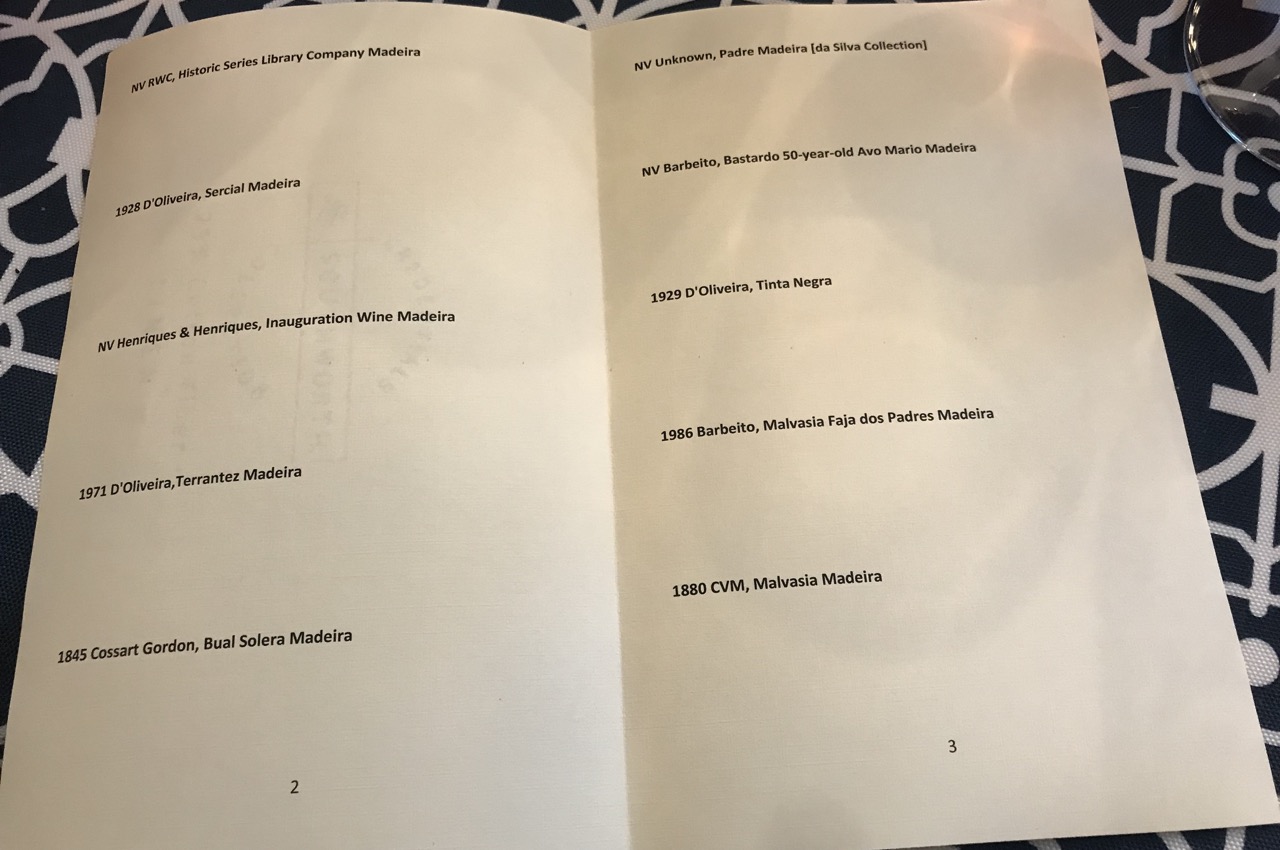
Madeira is a fortified wine available in a wide range of dry to sweet styles. It gets its name from the eponymous region of Portugal, an archipelago of four islands off the African coast. The green and volcanic main island of Madeira has pebbly beaches. Its capital Funchal is known for a large New Year’s fireworks show and Madeira wine? It gives off its own fireworks, as I discovered at this ring-in-the-new-year tasting.
Origins
Sailors to the Americas and the East Indies regularly stopped at Madeira for fresh water and supplies between the 15th and early 19th centuries. They brought on board wine barrels to provide needed sustenance for sailors, and to act as ballast. Of course no temperature control existed back then. It seems that both consumers and producers learned how the wine improved in quality as it traveled in hot tropical zones.

No need to cross the equator anymore.
The “Estufagem” aging process produces Madeira’s distinctive flavor. It is meant to duplicate the effect of the long sea voyages on the aging barrels through tropical climates. Three main methods are used to “heat age” the wine, used according to the quality and cost of the finished wine. The cheapest method is Cuba de Calor. High- end wines undergo the Canteiro process, by which wines are aged without the use of any artificial heat, being stored by the winery in warm rooms left to age by the heat of the sun. This process can last from 20 years to 100 years.
Madeira also became fortified. To prevent the wine from spoiling on long maritime treks, producers added brandy, a practice that took hold in the mid-18th century. The process continues today and all wines have in between 17.5% and 21% alcohol strength. Read More
Fronsac Focus
Posted on January 18, 2018

Tasting Bordeaux 2015 from bottle at The Grand Cercle
By Panos Kakaviatos for wine-chronicles.com
18 January 2018
It was great to catch up late last year with Alain Raynaud, founder of the Grand Cercle des Vins de Bordeaux. He associated this large group of over 160 Bordeaux producers back in 2013, uniting wines of the Right and Left Banks.
I was in the middle of tasting through most of these wines at the gorgeous Château de Pressac late last year when Alain dropped by to see how I was doing.
To get a sense of any given vintage, a Grand Cercle tasting is essential, bringing together a diversity of appellations, terroirs and wine professionals. One of my favorite appellations overall at that tasting for the 2015 vintage is Fronsac. Of course Pomerol shined bright, as I reported earlier already in these pages – and the Grand Cercle includes several Pomerol wines.
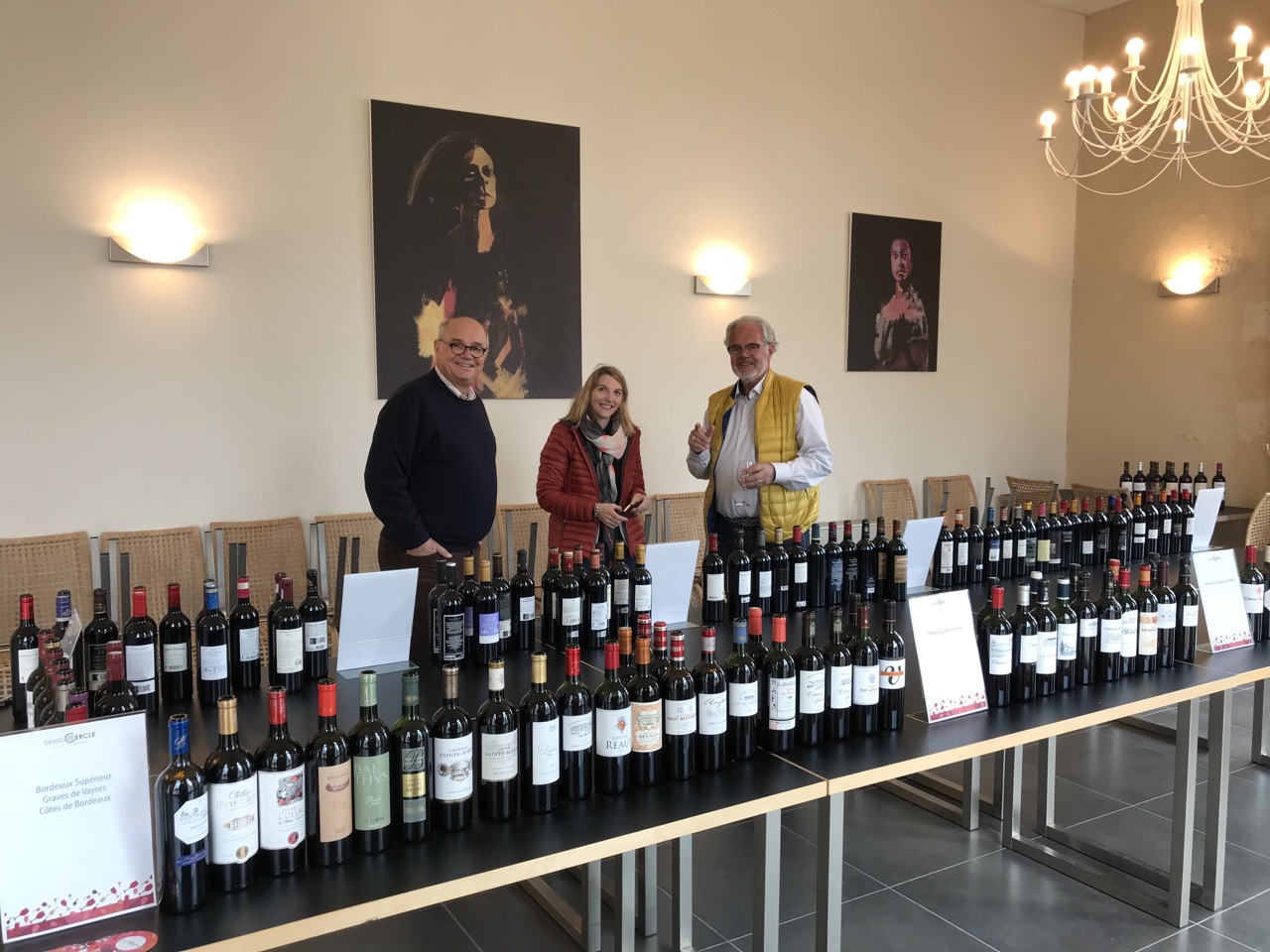
From left to right: Jean-François Quenin of Château de Pressac, Stéphanie Delécrin and Alain Raynaud at the comprehensive Grand Cercle tasting of 2015 recently bottled Bordeaux wines.
The Grand Cercle includes many so-called “satellite” appellations of Bordeaux including Côtes de Castillon, Lalande de Pomerol, Fronsac, Canon Fronsac, Bordeaux Superieur, Entre Deux Mers and Côtes de Bordeaux.
Alain and I discussed various aspects of terroir differences, for example, how a wine like Château Bourgneuf (Pomerol) seemed more impressive to me than the Feytit-Clinet.
“Logical,” Alain remarked, “as it is lower along the slope than Bourgneuf” (while Trotanoy, not a member of the Grand Cercle, is higher than both).
I arrived on a cold yet sunny morning of 30 November, to a spacious tasting room at the château, welcomed by the gracious owner, Jean-Francois Quenin, who is vice president of the association. The organizers have long taken note of my preference for more classically styled Bordeaux, and are always very supportive, even if I can be critical with some estates within the Cercle. À chacun son goût. Read More
Recent Comments