 Wine Chronicles
2024 Bordeaux: just before bottling
By Panos Kakaviatos for Wine Chronicles
15 April 2026
All eyes this month are on the promising 2025 vintage from barrel in Bordeaux, and the world is abuzz with an urgent need to get a successful en primeur campaign or else “en primeur is dead”, Edouard Moueix is quoted as saying in a Decanter article.
But en primeur has been facing possible death in recent years already, with too many overpriced wines and unsold stocks gathering dust in warehouses. How many times do Bordeaux brokers and negociants say that prices need to come down? Many times.
So where does the less heralded 2024 vintage fit into this picture? Olivier Bernard of Domaine de Chevalier spoke to me after I tasted scores of 2024 vintage wines just before their bottling, thanks to wine merchant Millésima in Bordeaux for inviting to taste.
I missed the barrel tastings last year because of a knee operation, and Olivier emphasized that 2024 is less expensive than 2021. “We learned a lesson with 2021 having been too expensive”, he told me, so that with 2024, you get wines at a lower price for the level of quality. He makes sense. And for lovers of Bordeaux, like a collector and fan I met last week while in Bordeaux, acquiring off vintages are worth completing a collection of brands he likes. Certainly 2024 will be a wine to enjoy while you wait for the 2018-2020, 2022-2023 to enter a mature drinking window, for example.
After tasting scores of 2024 wines, from the Right Bank to the Left Bank, I say buy with care, nonetheless. We’re living now in a fragile market, especially more recently with rising energy costs and people not drinking as much alcohol. And, as already stated above, there is a lot of unsold wine in the pipeline. Prices could go down even further, something to which I attest: I’ve purchased wine over the years in bond sitting in London warehouses, and I’ve lost about 30% of the value, as have other people.
We can talk about wine being a liquid asset and wine being liquid pleasure. If you’re looking at 2024, it does not pack as much pleasure as vintages like 2009, 2010, 2011, 2012, 2014, 2015, 2016, 2018, 2019 and 2020, let alone 2023 and what looks to be an absolutely lovely vintage in 2025. But, as Olivier noted, prices are low, so what to do? Younger buyers enthusiastic about Bordeaux should look to some estates and, based on price, they can go for it. Older buyers like me tend to buy back vintages that have become less expensive in recent years.
Volvo vintage
Tasting through these wines, I found that some lacked worthy mid palates, and when they did offer mid-palate juiciness and (some) depth, they often came with short finishes. I encountered some green tannin in a few wines. And yet, quite a few did very well! Hats off then to talented winemakers who were able to best make use of the challenging conditions! For details on these challenges, notably excessive rains at the wrong time, I recommend this summary by friend Colin Hay in Drinks Business, published last year.
Overall, the best efforts were those that did not try to make a Ferrari out of a Volvo, with all due respect to Volvo, which makes nice cars. And I think it was telling that when I went to Château Haut Bailly the night before for a (brilliant) tasting of the 2025 from barrel and the 2023, now in bottle, director Véronique Sanders said that the estate dubbed 2024 Singing in the Rain! I think that’s a positive way of looking at the vintage. She said that one should take each vintage as it comes and treat it with care, and Haut Bailly performed honorably in 2024.
Other than pricing, another bit of good news for 2024 is that it transcends the French adage petite année, grand vin, which means that in a weak vintage, go for the very best producers. And while that holds true for 2024, I am pleased to report that less heralded producers who treated the vintage for what it is; Look to the humble estate of Château de Sales in Pomerol or the rather economically priced Third Growth Château La Lagune to take two examples that did not over extract or over oak or over do, thus proposing decent wines to be enjoyed over lunch, without much thinking. In fact, while de Sales is more for luncb, La Lagune is more serious, and a better wine.
No point scores in this essay because I sometimes struggle with them. I like to use the 100 point scale, but it has long ceased being that way. Can a 2024 be a serious 96 point wine when compared to a 2022 or 2016? I do not think so. Heck, the 100 point scale is not even a 10-point scale because if a wine gets below 95, it is not considered easy to sell. Long gone are the days when 87 meant something, the equivalent of a B+ in U.S. grading, and a B+ should reflect wine that is good. Many 2024s should be more than happy with a B to a B+ for example. Give the A grades to top wines in top vintages like 2016.
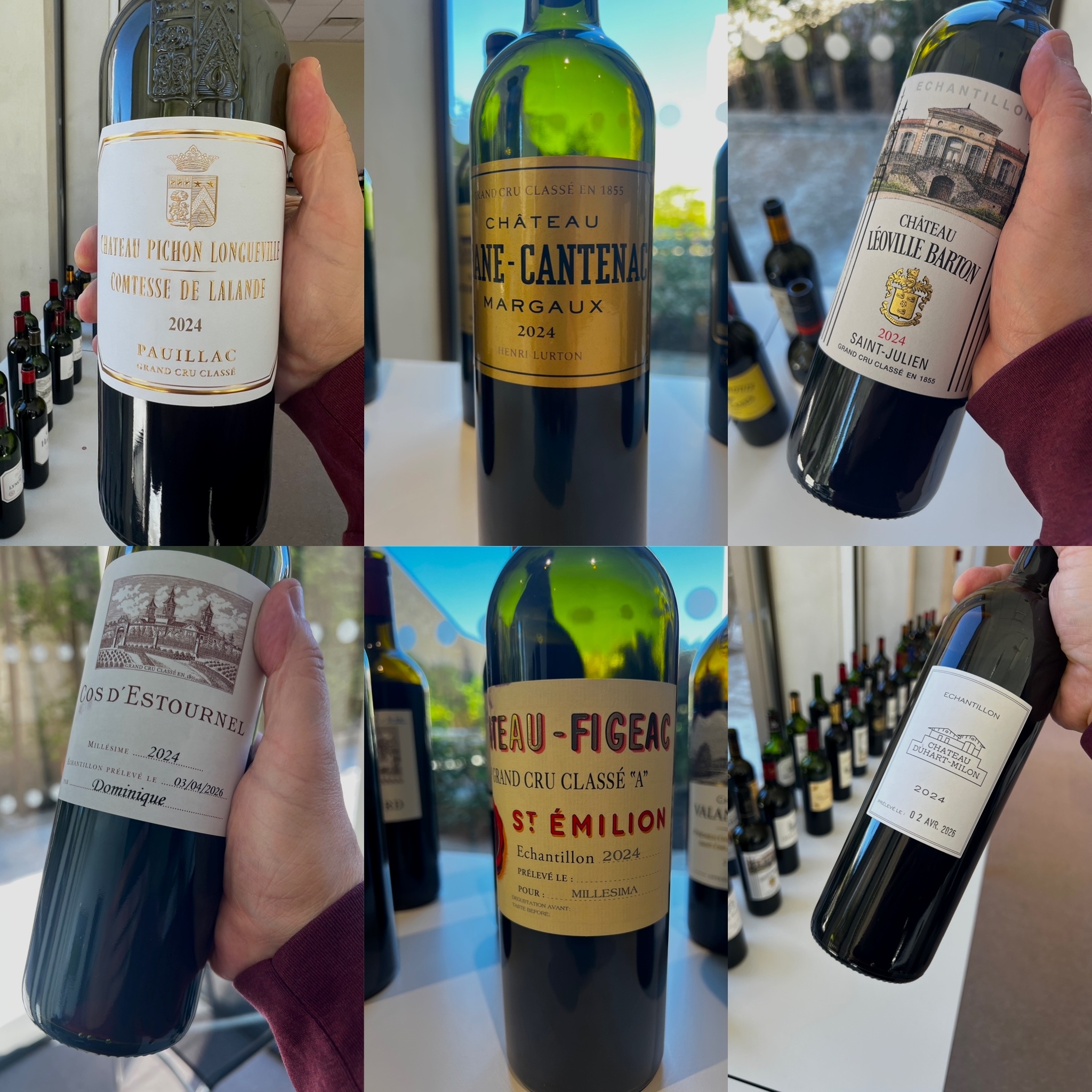
Six favorites from 2024, just before bottling
Some wines from the Millésima did not reach a quality level worthy of posting, so this listing includes a selection of my favorites. Instead of numerical scores, please follow a more general grading system: if in bold, I liked. If bold and red text, too, then the wine is extra special. Finally, if red, bold and underlined, then buy for certain. I did not get any asterisk* wines, which means wine nirvana. Let’s save that for 2025s in June, when I post notes on those barrel samples. 🙂
Each of the wines in alphabetical order. To jump to an appellation, just click on each category:
Saint-Émilion/ Pomerol / The Médoc / Others
RIGHT BANK
Saint-Émilion – Some very good wines in this appellation, and Château Figeac comes out on top among those tasted
Château Beau-Séjour Bécot Premier Grand Cru Classé (PGCC) Saint-Émilion – This blend of 78% Merlot and 22% Cabernet Franc, clocking in at 13% alcohol exudes fine ripe fruit aromas, with hints of limestone freshness, similar to that of Château Canon. The palate succeeds in conveying ripe fruit, quite like Clos Fourtet, with an extra bit of brightness. As with other 2024s, the finish comes up a bit short, but that is the nature of the vintage, as compared to aforementioned superior vintages: this is how the 2024 cookie crumbles.
Château Canon PGGC Saint-Émilion – Also a blend of 78% Merlot and 22% Cabernet Franc, aged in just under 50% new oak, the wine exudes vivid (and lovely) wet stone aromatics, like other wines on the plateau. I think of the fine Château Laroque for example, but Canon evinces superior aromatic depth. The palate is quite smooth, marked by refined tannin, thoroughly medium bodied, and not trying to be more. In a challenging vintage, this is quite good indeed.
Château Clos Fourtet PGCC Saint-Émilion – Another lovely nose after assessing the Canon. This blend of 84% Merlot, 10% Cabernet Franc and the rest Cabernet Sauvignon boasts one of the very best aromas from the tasting, so hats off. The palate does not quite follow through, but the cinnamon spice and the nicely ripe red and black fruit defy the wet (Singing in the Rain!) vintage identity. While Canon evinces wet (lime)stone, Clos Fourtet dares to – and achieves – a rare opulence for the vintage. It comes across more medium- than full-bodied, and the length does not match, say, 2023 or 2022 or 2015, 2016, 2018-2020, but this is very good wine for the vintage.
Château Dassault Grand Cru Classé (GCC) Saint-Émilion– This has character, with layered density to the palate. Even if, it lacks the éclat and vivacity of a better vintage, the aromatics evince damson, hints of fresh cut grass and vanilla. It is solid, medium bodied blend of 67% Merlot, 30% Cabernet Franc and 3% Cabernet Sauvignon clocking in at 13.5% alcohol, which has impressive depth for the pedigree – and the price.
Château La Dominique GCC Saint-Émilion – Sinewy aromatics of bright red fruit and tobacco leaf arise from this blend of 85% Merlot and 15% Cabernet Franc, clocking in at 13.5% alcohol. There is palate refinement with ripe fruit, albeit – yet again – with a somewhat shorter-than-expected finish, but let’s praise mid-palate juiciness. One of the more successful among the St-Émilion wines of 2024, with agreeable freshness on the finish.
Château Figeac PGCC-A Saint-Émilion – Floral nose with ripe, red berry fruit and plum. There is depth to the aromas that introduce a refined medium-bodied palate that is not trying to be more than the vintage offers, like other successful wines in this pre-bottling series at Millésima. In short, the wine is appealing, even if it tastes like a “lower gear” Figeac, as if the orchestra were missing a few instruments. Still, an impressive performance: no rough edges with one of the longest (sneaky) finishes of the 2024 vintage, from this blend of 39% Cabernet Sauvignon, 33% Merlot und 28% Cabernet Franc. Bravo! About 13.5% alcohol and aged 15 months in 100% new oak.
Château Fombrauge GCC Saint-Émilion – Licorice, black fruit, clove aromas presage a palate with depth. I can see this as a glass selection at a wine bar: it conveys pleasure. If not especially profound, a solid wine. As with many other 2024s, the finish ends a bit abruptly however.
Château Larcis Ducasse PGCC Saint-Émilion– Blending 85% Merlot and 15% Cabernet France with 13.5% alcohol, the somewhat muted aromas evince ripe enough fruit. The palate is balanced and poised and has more depth than many other 2024s encountered, so in a sense, the palate is quite successful. I just wish the fruit were more exuberant, so that explains a somewhat lower level of enthusiasm even if Larcis Ducasse clearly passes the 2024 test!
Château Laroque GCC Saint-Émilion – Lovely aromas reflect the limestone terroir: chalk, wet stone, plum. The palate lacks the depth of a better vintage, and a certain 2024 thinness comes through, alas, but rather successful for the vintage. I can imagine this with grilled steak or risotto mushrooms.
Château Pavie Macquin PGCC Saint-Émilion – Nuanced aromatics: floral, fruit and spice. The palate is suave and agreeable – more successful than sister estate Larcis Ducasse. Sure, this blend of 84% Merlot, 15% Cabernet Franc and 1% Cabernet Sauvignon, at 13% alcohol, comes up a bit short on the finish, but the wine conveys an undeniably savory mid palate. Nice job.
Château Trotte Vieille PGCC Saint-Émilion – This estate famously blends in a majority of Cabernet Franc and 2024 is no exception, at 56% Cabernet Franc, 41% Merlot and 3% Cabernet Sauvignon, clocking in at 14% alcohol. A spicy, nutmeg aspect, with a velvety palate touch, the tannic structure is noticeable but not hard. The estate has achieved a fine level of ripeness for the vintage, and I think cellaring will be rewarded for the tannins to integrate more. Overall, a fine job here.
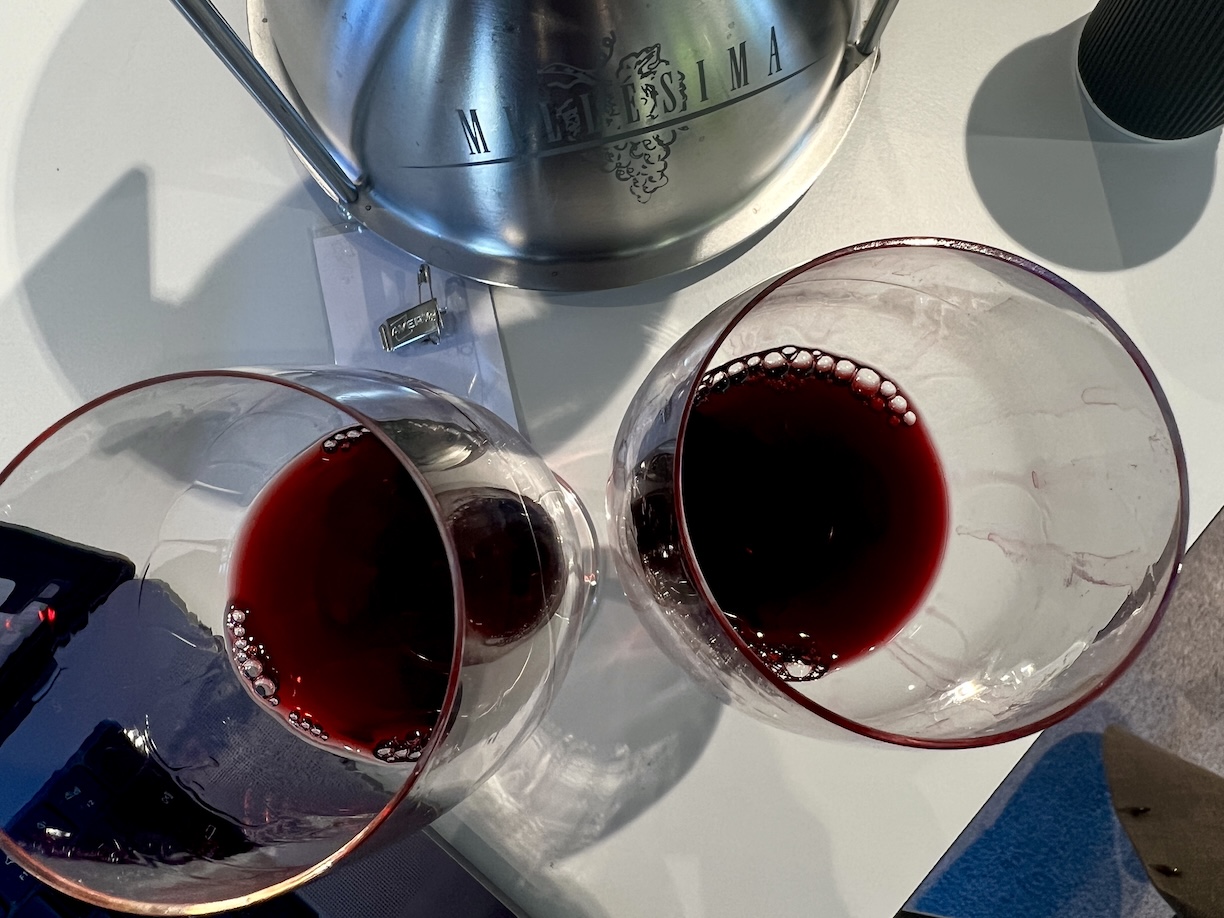
Many 2024s showed light tones and transparency, but not so Château Valandraud, at right – as compared to Château Pavie Macquin, to the left.
Château Valandraud PGCC Saint-Émilion – There is a richness to the nose that reflects also the 100% new oak for aging, but the oaky aspect is not as blatant as it has been in earlier vintages. The palate exhibits ripe fruit, juiciness, with some new oak tannin but – again – I am impressed how the wine is not like sucking an oak stick, as the new oak has been (largely) absorbed, and I get little drying out sensations that I had gotten in some past vintages. Check out the darker color as compared to the Pavie Macquin.
Pomerol – Among the wines tasted, Château Evangile on top
Château Beauregard – This blend of 67% Merlot, 24% Cabernet France, 9% Cabernet Sauvignon at 13% alcohol has medium-body and depth that appeals, a successful wine for the vintage, with ripe Merlots that count. It lacks the profundity of a better vintage, but overall, a pleasing drink. Some ripe red apple freshness, along with plum mark the finish.
Château La Conseillante – No surprises here, as the aromatic and palate finesse is unmistakable from this top estate in the appellation: a wine of breed with gorgeous floral aromatics, with an elegant palate. On the other hand, this blend of 80% Merlot and 20% Cabernet Franc lacks the depth and length of better vintages, so depending on the price, one may or may not choose to purchase. Then again, a worthy addition for fans of the wine for cellar completion!
Clos du Clocher – A more serious aromatic profile than neighbor Château Beauregard, with more evidently darker ripe fruit, along with oak-derived aromas and licorice. I get more verve, more spine from this wine, albeit lacking – again – the depth you would get from a 2022 or a 2018. The tannins that bring structure are quite in evidence: not hard but edgy. Give it time to settle. Not great, but good. Have I said that enough?
Château Evangile – Here a wine that clearly stands out among its 2024 peers as it conveys depth, refinement and even ripe charm. One of the top aromatic expressions of the entire tasting at Millésima, with plum and spice, violet (and violet stem). Unlike many 2024s, one gets a sense of genuine breadth. Sure, not as much as in 2022 or 2023, for example, but it comes across successfully.
Château Petit Village – Like sister estate Château Beauregard, a smooth wine that has freshness: nicely done wine!
Château de Sales – Pleasing, bright fruit aromatics with a bit of fresh meadow. The light bodied wine has appeal, if not particular depth. Solid. For the price, if low enough, why not? Smooth tannins that count, too.
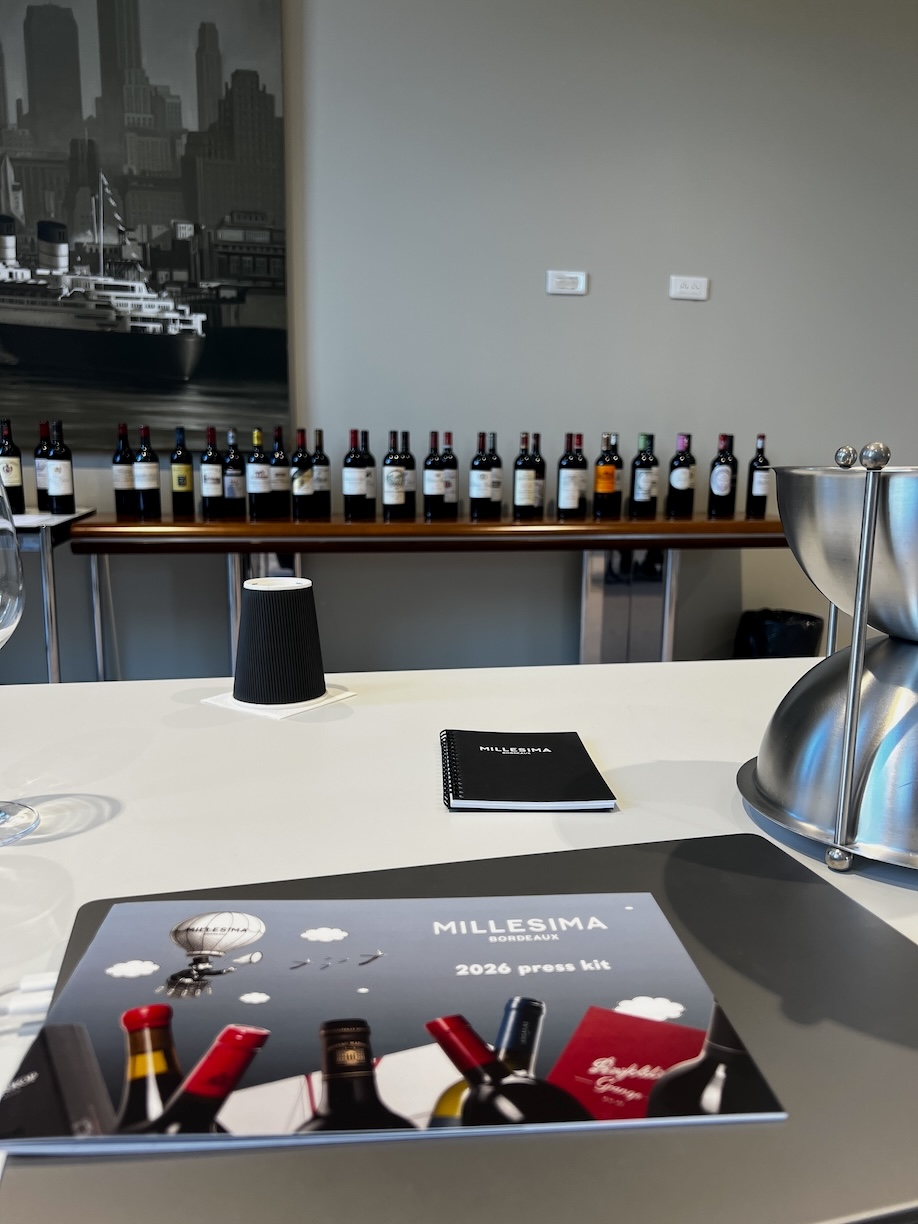
Quiet tasting room, thanks to Millésima
Margaux – Among the wines tasted, Château Brane Cantenac comes out on top, although other brands (Giscours, Palmer and d’Issan) come very close
Château Brane Cantenac – Lovely notes of crushed mint leaf and ripe red berry fruit emanate from this blend of 77% Cabernet Franc, 22% Merlot and 1% Cabernet Franc. The palate structure is excellent with smooth tannin, proving that reaching high in a middling vintage like 2024 yields results. Quite juicy for the vintage, but neither as long nor as deep as better vintages, and yet there is something particularly special about Brane in 2024.
Château Durfort Vivens – Straight-up honest to the vintage, no rough edges, well-made wine, exuding salinity, red fruit and a certain savory aspect to the medium body. While optimal ripeness is not quite reached, one senses nice wine with tannic structure and a smooth palate, leaving one with the thought that the estate made an honest attempt to craft as best a possible a wine under wet conditions.
Château Giscours – This blend of 60% Cabernet Sauvignon, 31% Merlot, 6% Cabernet Franc and 3% Petit Verdot exudes licorice notes and rather ripe fruit with vibrancy on the mid palate. A successful 2024 – one that you should not hesitate if encountered at a restaurant and the price is right.
Château d’Issan – This Margaux Third Growth excels in the vintage, similar to Brane Cantenac, officially a Second Growth. I like the ripe fruit, moderate depth and palate nuance from this blend of 65% Cabernet Sauvignon, 35% Merlot and the rest bits of Cabernet Franc, Petit Verdot and Malbec having aged in 50% new oak. Nice job!
Château Palmer – Refined aromatics, some oak-derived notes, but also ripe fruit and spice. Fine depth, smooth tannins, but also foreboding tannin that needs time to settle. An impressive Palmer for the vintage.
Château Rauzan Segla – Plenty of depth and truly rises to the occasion as a Super Second, with ripe fruit and power, too, without being hard. It lacks charm and refinement, however, something that one would normally obtain from this mighty estate, but it is 2024.
Saint Julien – I did not taste as many as I would have liked, given time constraints, but among the wines tasted, Château Léoville Barton comes out on top
Château Branaire Ducru – Pleasant aromas. Playing safe, not over extracted, light and pleasing, and exuding what you want from Saint Julien: charm.
Château Léoville Barton – Pencil lead, ripe black fruit and racy aromatics: very nice. Smooth palate, wow, this is quite nice indeed, how did they do that? It lacks the depth of a better vintage but this counts among the smoothest and most appealing expressions of 2024 tasted at Millésima. It lacks a long finish but is nonetheless absolutely lovely, and for the price, very worthy!
Ch Leoville Poyferré – Very good ripe fruit expressions, and I like the power on the palate. Like Lynch Bages, rather excellent for the vintage. But also somewhat disjointed, as the tannins seem to be protruding rather than integrated. But it should come together with time in your cellar.
Pauillac – A strong appellation for the vintage with good to very good wines. Pichon Comtesse gets my nod as the best
Château d’Armailhac – This blend of 72% Cabernet Sauvignon and 14% each of Merlot and Cabernet France exudes nuance and some refinement. I get a sense of care in crafting this wine, no roughness, and character. Bravo!
Château Batailley – Well done, this blend of 81% Cabernet Sauvignon, 15% Merlot and one per cent Petit Verdot: rather subtle power, ripe fruit, not drying. It is not the most consequential either among these fine Pauillacs, but an “honest” wine for the vintage!
Château Clerc Milon – Compared to the sister estate d’Armailhac, I get more evident power from this blend of 66% Cabernet Sauvignon, 24% Merlot, 8% Cabernet Franc and one per cent each of Carmenère and Petit Verdot. The tannic edge is present but, again, not hard. This is another fine wine for the vintage. Aging in 55% new oak.
Château Duhart Milon – An even better wine than the above, this blend of 78% Cabernet Sauvignon and 22% Merlot communicates more class, more refinement, and even more (subtle) power. I like this quite a bit. Great team behind the wine, to be sure. A top Pauillac for the money. Bravo!
Château Grand Puy Lacoste – This blend of 78% Cabernet Sauvignon and the rest Merlot and 13.5% alcohol gets close to my wine of the appellation, as it comes across rather spherical: juicy, nuanced, and smooth. What more do you want from a 2024?
Château Haut Bages Liberal – This has power and smooth tannin, and I prefer it to Lynch Bages on one level, in the sense that it has some initial charm, but it comes across a bit clumsy/disjointed through to the finish, which is not the case of Lynch Bages, tasted alongside.
Château Lynch Bages – As expected this blend of 70% Cabernet Sauvignon, 24% Merlot and the rest even parts of Cabernet Franc and Petit Verdot packs plenty of tannin. The power impresses, but just a bit of dryness on the finish annoys. Having said all that, pretty impressive – this power – in a vintage that too often seems stuck in a lower gear. Give it time in your cellar.
Château Pichon Longueville Baron – Royal elegance aromatics. The announcement is bold and the palate has power, yes! It comes across just a bit drying. However, the depth impresses more so than other wines, even if I still hold a special place for GPL – and Léoville Barton. Whatever the case may be, if you are a Baron fan and seek completion, the 2024 is worthwhile.
Château Pichon Longueville Comtesse de Lalande – Hats off to Nicolas Glumineau, because he and his team have crafted an absolutely lovely wine in 2024! OK, a smidgen of drying on the longer than usual for the vintage finish but otherwise, juicy and bright, this blend of 83% Cabernet Sauvignon, 14% Merlot and the rest Cabernet Franc. One wants to keep taking another sip, which is a rare quality for 2024.
Saint Estephe – Among those tasted, Cos d’Estournel on top
Château Cos d’Estournel – What class and breed! This blend of 65% Cabernet Sauvignon, 33% Merlot and 1% each of Petit Verdot and Cabernet Franc, clocking in at 12.8% alcohol exudes subtle power and tannic refinement, illustrating the French adage petit millésime, grand vin. Cos is one of the very top wines of this tasting, much like La Comtesse in Pauillac. Bravo!
Château de Pez – One of the more successful 2024s for the price point, no rough edges, has medium length, too. Nuanced palate, smooth tannins and yet there is a hardy St Estephe aspect that appeals and even begs for cellaring. Bravo !
Château Phelan Segur – Lovely wine! Handled the rains nicely. A bit drying on tdhe finish but with a juicy mid palate. Lacks the follow through of a better vintage, but that’s 2024 for you.
Due to limited time, I could not taste as many wines as I would like and took more cursory notes, but special for a fine showing from Château La Lagune, which came across smoothly and comparatively elegant compared to its peers. I also especially liked Château Pape Clement for its ripe fruit and medium body. It lacks the charm and refinement of a better vintage, but nice job in 2024. Both Domaine de Chevalier and Château Haut Bailly also performed honorably for the vintage.
To conclude, it is important to note that while recent years have often been defined by warm, dry and frequently successful conditions, in vintages like 2018, 2019, 2020, 2022, 2023 and now 2025, vintages like 2021 and 2024 remind us that climate change expresses itself in multiple ways, including periods of excessive rainfall during the growing season, posing different challenges for growers. Hats off to the winemakers for making the best possible wines under such conditions. As we get excited about the promising 2025 tastings from barrel, let’s not overlook quality from the 2024 vintage, as one can find some gems and if the price is right, why not?
Share This