 Wine Chronicles
#Bdx17: Best of the red rest
Posted on May 27, 2018

Right Bank Satellites
By Panos Kakaviatos for wine-chronicles.com
26 May 2018
2017 makes the adage of seeking a “petit château” in a great vintage (and vice versa) less clear-cut. Certainly top terroirs excelled – on a general basis – so you can (more often that not) find happiness from the “grands châteaux” in 2017 – if the price is right. By the way, too often so far, the price has notbeen right, what with the wide availability of vintages like 2015 in bottle and at comparable prices, not to mention 2014s that can be just as good as the 2017s.
To get your money’s worth, this time “grand château” also means estates from lesser known appellations, whose terroirs suffered little or no frost damage, while having enough warmth and properly draining soils to ripen grapes in the somewhat sunless summer – and to withstand more effectively September rains.
So, you could actually find “petits châteaux” from fine terroirs that may be more interesting than even some classified growths that were hit more by the frost.
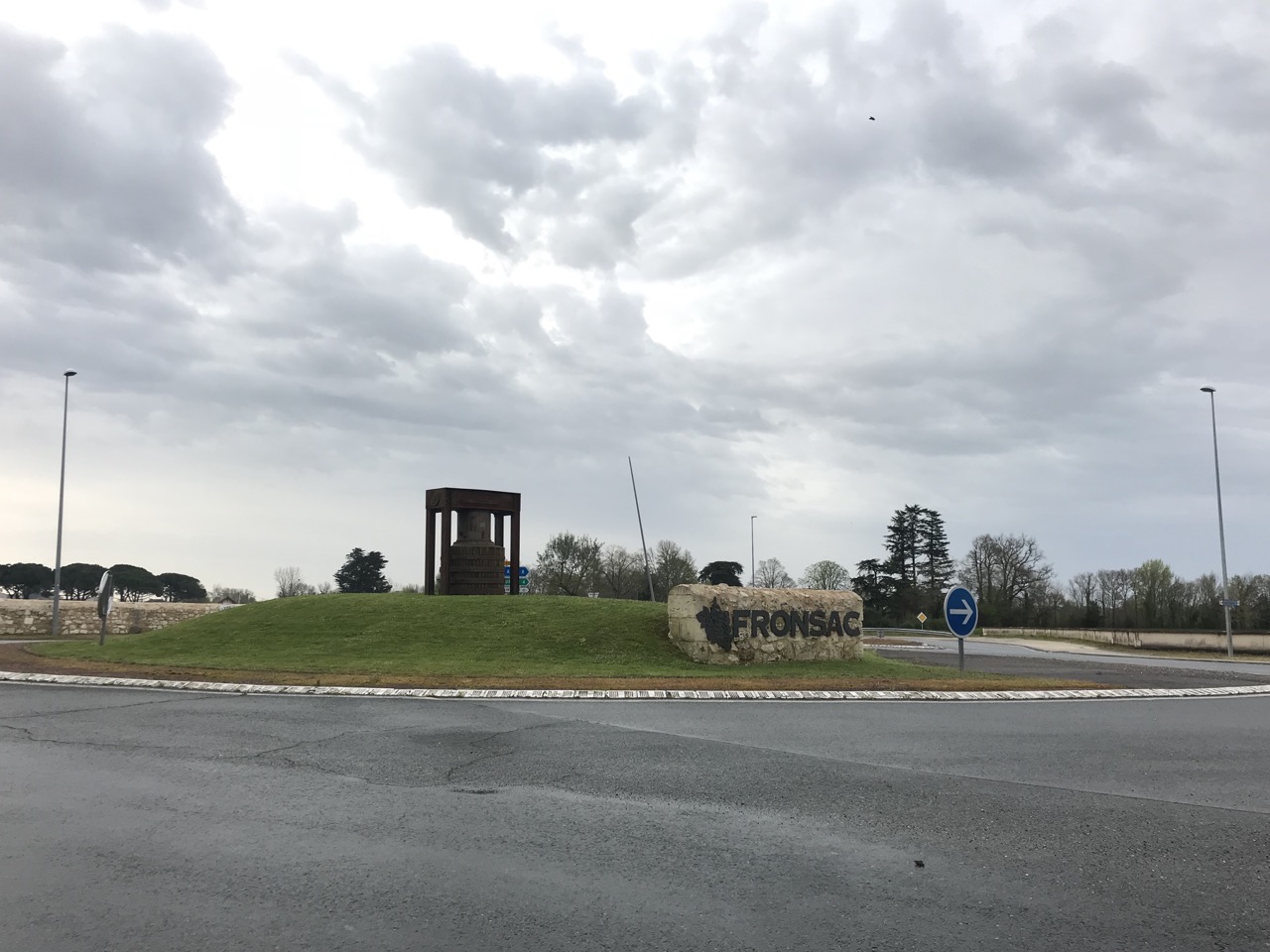
This section thus takes a closer look at this fascinating aspect of 2017, and two examples come to mind: Château de la Rivière in Fronsac, unaffected by frost, made very fine wine in 2017. We have already seen how an estate like Château de Lamarque in Haut-Médoc made wine that outclasses some classified growths: its proximity to the river meant riper grapes and less frost challenges, and riper Cabernets than some others. Neither of these wines will dent your wallet.
Many of these “smaller” success stories come from the members of the Grand Cercle, which includes wines that in warm to hot vintages make over bold, high alcohol and sometimes too oak-ridden wine. Given the nature of the vintage, which was not amenable to such large scale styles, some special cuvées from the Grand Cercle which I tend to find overblown actually excel in 2017 – and would be worth purchasing should the promise of the barrel samples be fulfilled in bottle. In terms of appellations, yet again Fronsac proves its mettle and for that reason I highlight it in the main photo for this post. Read More
Margaux merits #Bdx17
Posted on May 24, 2018

The Médoc, Part III
By Panos Kakaviatos for wine-chronicles.com
24 May 2018
After examining Pauillac, Saint Julien and Saint Estèphe in Part I and Haut-Médoc, Listrac-Médoc and Moulis-en-Médoc in Part II, now to the barrel samples of Margaux.
They include more classified growths than any other Médoc appellation: 21. Margaux is the only appellation whose sole first growth bears the same name: the legendary Château Margaux. While tasting at the negociant Joanne, I assessed several cru bourgeois level Margaux wines, as well.
My overall Margaux thoughts? Some border on magnificent. Others more mundane: This is no 2015 vintage that lifted all boats.
Towards the “bottom of the barrel” you get harder tannins, sometimes even green, or, in one annoyingly persistent case: too much oak-derived tannin – and I am not talking about Lascombes, for once. ?
My top three? Margaux, Palmer and d’Issan
My top three (relative) bargains? Ferrière, Labégorce and Prieuré Lichine
As per usual, wines in bold, I liked in particular. If red and bold, even more. If underlined, too, a kind of barrel sample tasting nirvana. Wines tasted – more or less – in order of preference.
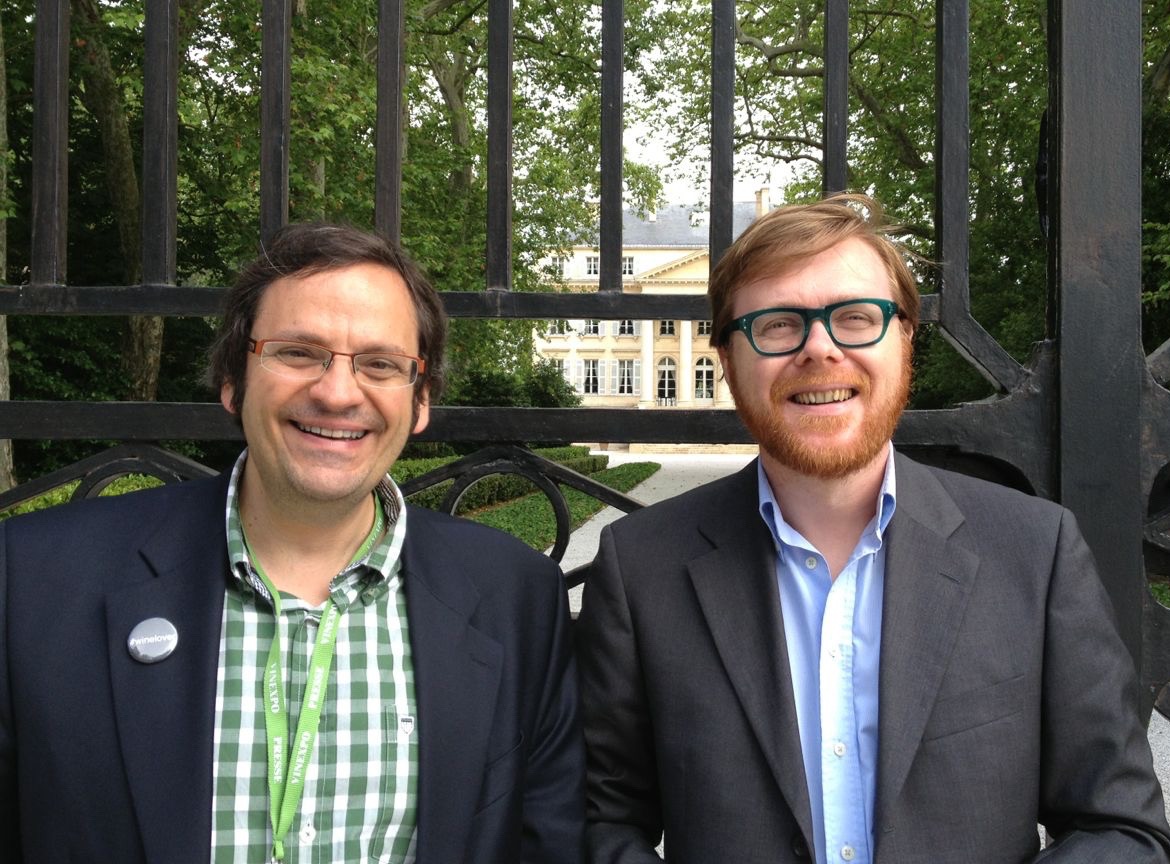
Easy to smile at Château Margaux. With wine pal Guillaume Deschamps a few years ago: the classic facade photo never goes out of style!
Château Margaux – Quite lovely, but while tasting the barrel samples with Jane and Francis Anson, Miguel Lecuona and Elin McCoy of Bloomberg, I felt almost more impressed by their Pavillon Blanc (reviewed in dry white Bordeaux section, coming up). Read More
#Bdx17 from barrel: Sauternes & Barsac
Posted on May 23, 2018

Residual sugar to the max?
By Panos Kakaviatos for wine-chronicles.com
23 May 2018
I am not sure about the overall quality of Sauternes and Barsac in 2017. Some critics have oohed and ahhed about the richness of these wines, including the super star Château d’Yquem. But I am a fan of late-harvest Bordeaux that have more verve and energy. 2017 is a vintage of richness to be sure. The balance tends towards higher-than-average residual sugars but just average to low acidities. There is ample botrytis, for most of the wines, which is a good thing.
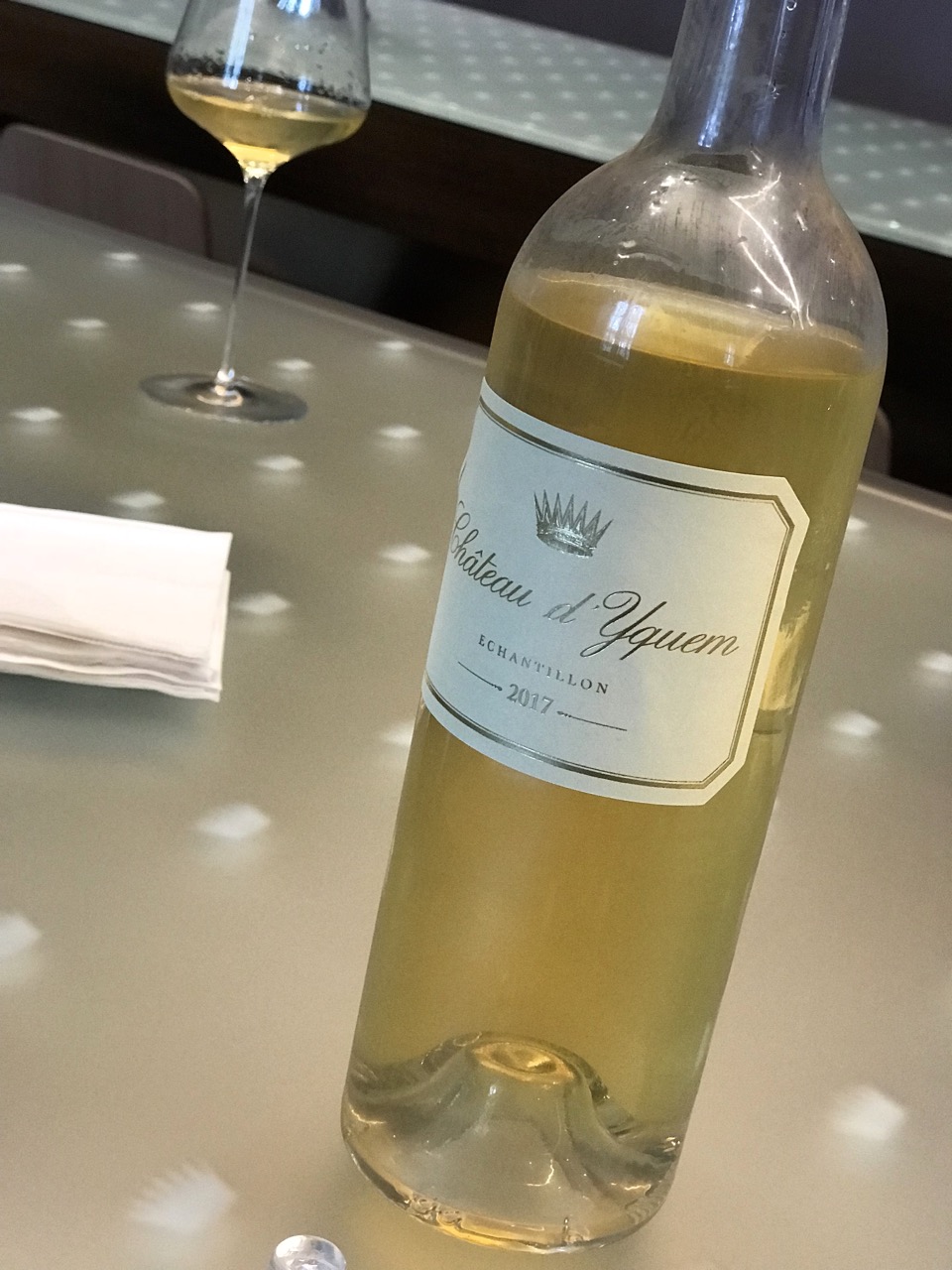
An excellent Yquem. But it felt challenged in 2017. Imagine how the others felt.
Add to all that the issue of frost. As with other parts of Bordeaux, lower areas were the worst hit. The famous estate Château Climens in Barsac opted out of the vintage entirely. Some properties however were spared, especially warmer and more precocious vineyards: Yquem, to take a notable example, among others.
The rather hot and dry summer led to already ripe grapes by mid-August. But here’s the catch: For many, the botrytis came a bit (too) late, resulting in concentrations “at times even too much” remarked noted harvest observer (and Sauternes promoter) Bill Blatch. Indeed, at Château d’Yquem, chief winemaker and cellar master Sandrine Garbay said that the main challenge was picking grapes with enough botrytis, but not with too low relative acidity.
Some estates did better than others. Cooler terroirs in Barsac not as hit by frost seemed to convey more vivacity, as expected, and wines like Château Doisy Daëne and Château Coutet count among my favorites in 2017. Read More
#Bdx17: The Médoc, part II
Posted on May 21, 2018

Assessing Haut-Médoc, Listrac-Médoc and Moulis-en-Médoc
By Panos Kakaviatos for wine-chronicles.com
21 May 2018
This section on #Bdx17 from barrel focuses on three Médoc appellations not as famous as those in Part I but known for quality wines at generally lower prices.
Certain wines here indeed could constitute bargains… in the longer run. And as we saw with Part I, most of these “see the river” but this is not a hard and fast rule, as you can read in the tasting notes ?.
My overall favorite in this section? Château La Lagune. It retails for about $50 in futures. I suppose that is on the high side, taking into account taxes and delivery charges, but it did very well in 2017.
Château Cantemerle is a close second place. But one of the wines that really excelled, for its caliber, was Château de Lamarque, whose price as of this writing is not yet released. I suspect it will be lower than that of either Cantemerle or La Lagune, both of which are “classified growths” of already celebrated reputations.
Already Château Poujeaux – the best of the Moulis-en-Médoc I tasted from barrel – has been released for a rather reasonable $30.
In any case, these brands are readily available off-the-shelf in bottle in earlier vintages, some more successful than 2017, and for similar pricing. So no urgent need to tie up your money up for two or three years before you get the 2017s. This is not a speculative vintage. The 2015s and 2014s, both fine vintages, are available now.
Whatever you decide, it is important to note how these 2017s performed, for future reference.
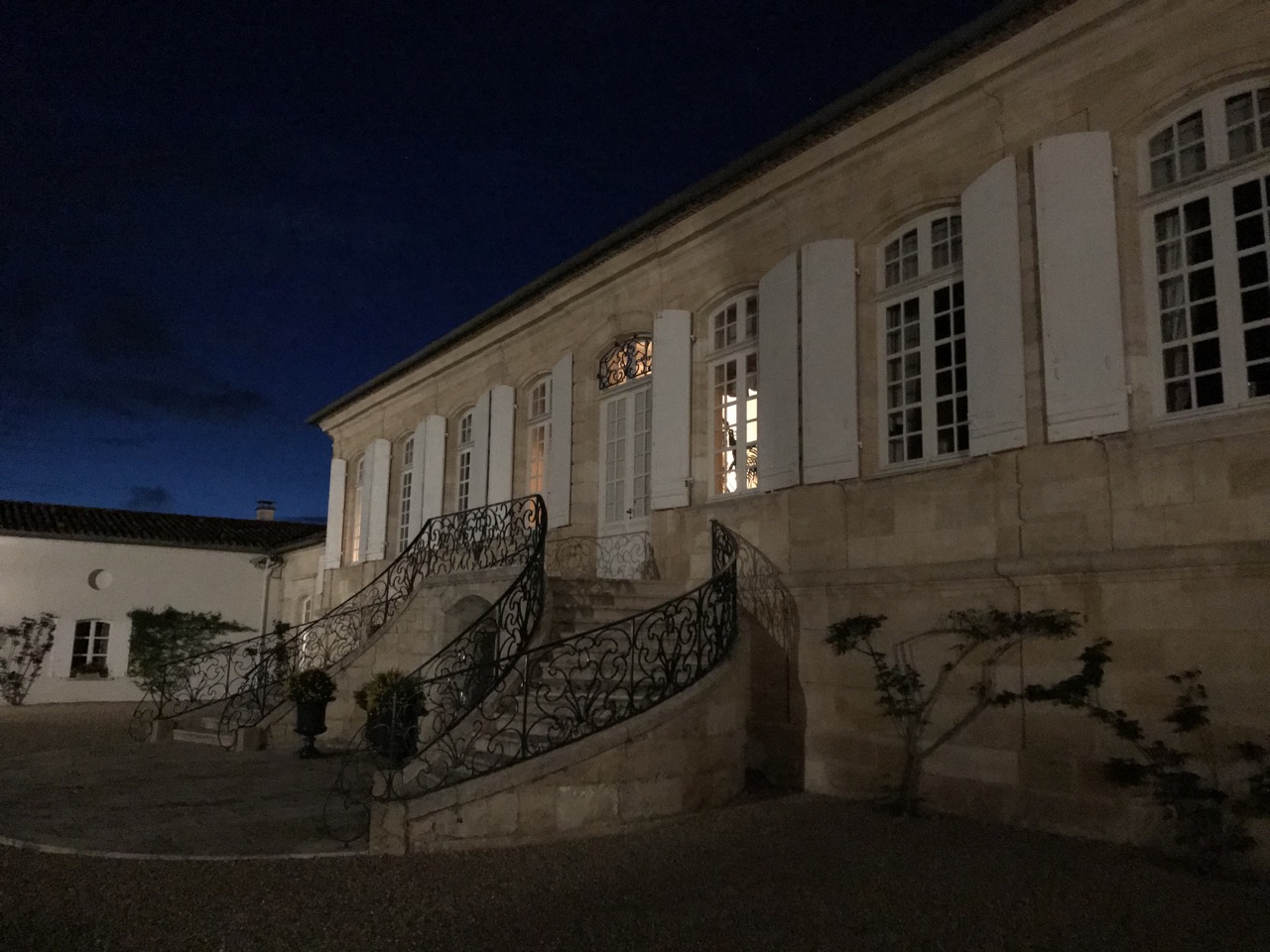
The elegant facade of Château La Lagune by night. The estate produced arguably the best AOC Haut-Médoc wine in 2017.
In order of preference for each appellation, with the usual preference for wines in bold. And, if red and bold, even more. Read More
Bravo Heart’s Delight!
Posted on May 18, 2018

Record-breaking $1.8 million raised to fight against cardiovascular disease and stroke
From press releases – 18 May 2018
For the 19th year in a row, Washington D.C. was all a (wine) buzz with the 19th Annual Heart’s Delight Wine Tasting & Auction.
After four days earlier this month of gourmet dinners, wine tastings and exciting auctions, this year’s event raised over $1.8 million for the American Heart Association, making it the most successful Heart’s Delight’s event to date.
Heart’s Delight gathered master winemakers, culinary greats and other distinguished guests to the capital of the United States. The four-day celebration of exceptional food and wine benefits the American Heart Association.
With this 19th edition of generosity from around the world, Heart’s Delight has raised nearly $22 million for the American Heart Association so far.
Highlights from the live auction this year included the following:
- Thibault Pontallier of Château Margaux on stage presenting a Jeroboam Château Margaux 2005, which sold for $42,000;
- Hervé Berland of Château Montrose on stage presenting an Imperial Château Montrose 2010, which sold for $18,000;
- Famous chef Daniel Boulud on stage presenting a surprise lot – dinner for 10! – which sold for $22,000;
- A 12-bottle Château Margaux 1983 (in original wooden box) vintage lot, which sold for $28,000. And that vintage is just amazing!
Recent Comments