 Wine Chronicles
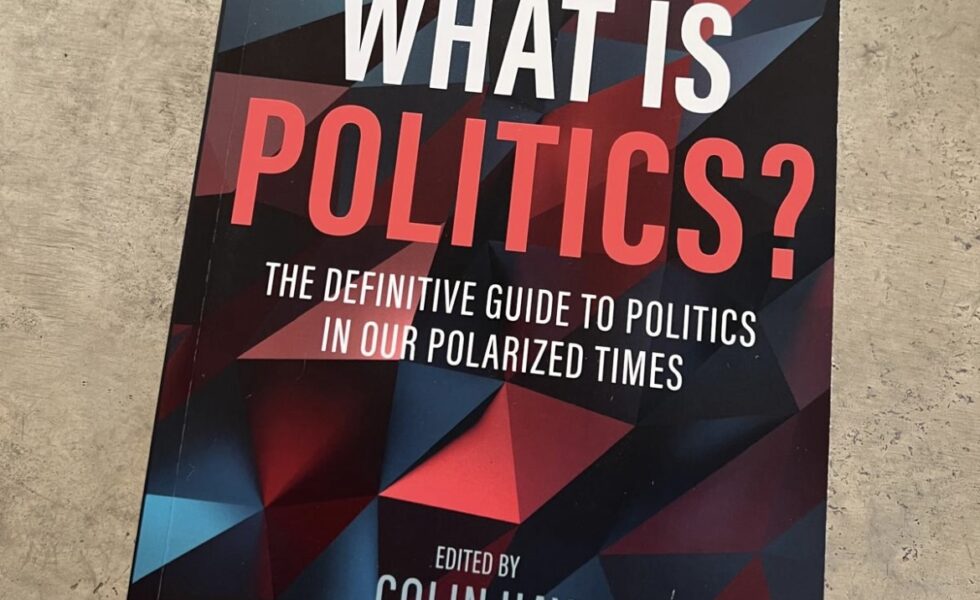
What Is Politics?
Reading a friend’s book, thinking politically
Book review by Panos Kakaviatos
26 December 2025
There is a challenge to review a book edited by a friend, especially when that friend is a political scientist and one’s own professional life unfolds in a different, if adjacent, register.
Colin Hay and I have known each other for several years, tasting and reviewing wines in Bordeaux especially. But we both inhabit worlds that are political, though not in the same way. Colin approaches politics analytically, as a professor and theorist. I encounter it more obliquely, through media relations at the Council of Europe, and – perhaps unexpectedly – through wine writing, where questions of identity, power, tradition, and belonging are never far below the surface.
It is precisely this shared but differently practiced relationship to politics that makes What Is Politics? The Definitive Guide to Politics in Our Polarized Times such an interesting book to read from outside the academy, yet not outside politics.
Hay’s introduction sets out the intellectual ambition with characteristic clarity. Politics, he argues, is not reducible to what politicians do, nor exhausted by elections or institutions. It is a broader process of collective choice-making under conditions of contingency: conditions in which neither fate, tradition, nor technocratic management can plausibly absolve us of responsibility. This framing resonates beyond political science. Anyone who has watched cultural traditions defended, contested, rebranded, or instrumentalized (in gastronomy no less than geopolitics) will recognize the terrain.
The book’s structure reflects this expansive view. Each chapter approaches politics through a different analytical lens: power, moral choice, collective action, behaviour, identification, gender, cognition, ritual, rhetoric, crisis management. At times, the language is unapologetically technical. This is not a book that flattens political theory for ease of consumption. But its seriousness is also its virtue. It insists that how we conceptualizepolitics shapes what we expect from it, and what we excuse when it fails.
For me, the most compelling chapter is Vivienne Jabri’s “Politics as identification.” It is here that the book speaks most directly to the political moment we inhabit. Jabri explores how identities – national, ethnic, cultural, gendered – are not simply inherited facts but are produced, performed, and mobilized through practices of identification. Identity, in this sense, is not outside politics; it is one of its most powerful currencies.
What makes this chapter especially valuable is that it resists easy moral sorting. Identity politics is presented neither as progressive virtue nor as reactionary vice. It is shown instead as a political force that can enable recognition, solidarity, and resistance, but also exclusion, hierarchy, and simplification. The danger arises when identity hardens into destiny, when politics becomes a struggle over who is rather than what ought to be done.
Read this way, the chapter offers tools for understanding abuses of identity across the political spectrum. Progressive struggles for recognition can slide into moral absolutism; conservative or nationalist appeals to heritage can become civilizational dogma. In both cases, the move is the same: difference is essentialized, disagreement moralized, and politics reduced to a friend. That insight feels particularly urgent today.
Some readers may find the book’s conceptual vocabulary (gendered politics, performativity, institutionalized exclusion) more familiar or persuasive than others. The volume emerges from traditions of critical political analysis, and it does not pretend to ideological neutrality. But that, too, is part of its honesty. Like good wine writing, good political analysis is never written from nowhere. It reflects choices (of lens, emphasis, and framing) that deserve to be made visible rather than disguised.
Perhaps that is where my own reading converges with Colin’s project. Wine writing, at its best, is not just about flavour; it is about place, memory, power, legitimacy, and who gets to define value. Media relations at an institution like the Council of Europe is not simply communication; it is the careful navigation of language, identity, and representation in a crowded political space. In different ways, we are both engaged in what Hay describes as politics: making sense of collective choices under conditions of uncertainty.
What Is Politics? does not offer comfort, nor does it offer slogans. It offers something rarer: an invitation to think more carefully about the categories we use when we say something ispolitical, or insist that it is not. In polarized times, that invitation is not merely academic. It is political.
Share This