 Wine Chronicles
Just in time for the holidays: Dinner at Giscours
Biodiversity contributes to Margaux Renaissance
By Panos Kakaviatos for Wine Chronicles
12 December 2025
It had just rained when I arrived at Château Giscours – the eve of my birthday on 5 December this year. Under a veil of evening mist, the estate had fallen into contemplative quiet. As my car that early evening rolled down the long approach off the main D2 road that lines the famous châteaux of the Médoc, the first beings to welcome me were not employees. It was not the grand silhouette of the château itself. But a flock of Landes ewes, grazing peacefully in the semi-darkness. They lifted their heads with mild curiosity, as if to signal that at Giscours, the land speaks first.
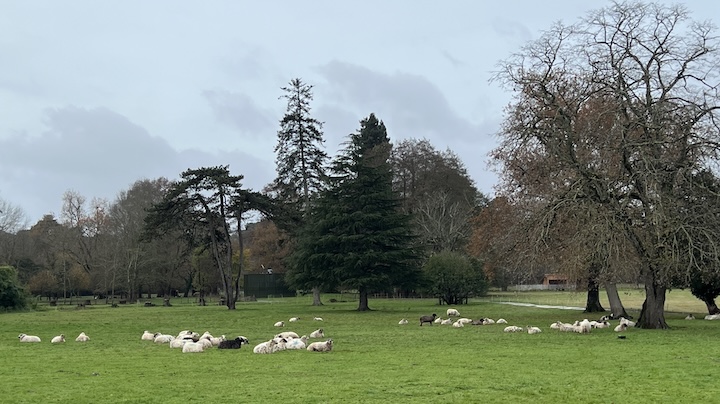
Morning after dinner: Some sixty Landes ewes, together with their lambs, maintain the park and meadows at Château Giscours as the seasons change.
This encounter was as charming as it was symbolic. Giscours is one of the rare Bordeaux estates where agricultural life has marked a return as integral to identity. The ewes – along with Bordelais cattle, goats, ducks, geese, and hens—form part of an eco-pastoral system that maintains more than 150 hectares of meadows, forest and parkland. The estate collaborates with the Conservatoire des Races d’Aquitaine to preserve endangered local breeds. Biodiversity here is not merely marketing; it has become part of the château’s identity.

The Château Giscours Margaux, tasted three times since bottling, is excellent in 2023, but even the estate’s Haut-Médoc, above, is fine. Some 60 hectares under vine are used for the Haut-Médoc.
But beyond that, the wines at Giscours have improved in quality. Markedly. I recall an old friend of my father’s, an avid Bordeaux buyer, back in the late 1990s. He said that “it is a waste of time to buy wines like Giscours when you can purchase Palmer,” referring to the superlative (also officially Third Growth in the 1855 Classification of Médoc wines) of Château Palmer. Admittedly, Château Giscours dipped in quality from the mid-1980s and 1990s, with a low price to be sure compared to Palmer, but Palmer was not as expensive back in the late 1990s as it became in the 21st century.
While Château Palmer deserves a promotion in a theoretical revamping of the 1855 Classification, the perception of Château Giscours as a clearly inferior wine no longer holds. Indeed, Château Giscours now reflects a cream of the Third Growth crop (Note to readers, I have an article coming up next year in Decanter Magazine comparing all of the Third Growths).
Indeed, over the past two decades, and especially in recent years, the work carried out under the steady hand of Alexander Van Beek, director since 1998, has fundamentally improved the wines of Giscours. This transformation has not come through flashy shortcuts, but through attention to detail: vineyard restructuring, parcel-by-parcel vinification, precision harvesting, gentler extractions, and a clearer vision of balance over power. And attention to personnel.
Take the relatively recent hire (January 2021) of the young, but already experienced Jérôme Poisson, 43 years old. Poisson mirrors Van Beek’s focus on detail combined with his vineyard and vinification work across the world, from Chile and the United States, to Alsace, Italy and – since 2021 – Bordeaux. He has contributed to the steady climb in the wine’s consistency, definition, and elegance. That is to say, wines that now marry Margaux perfume with substance and longevity.
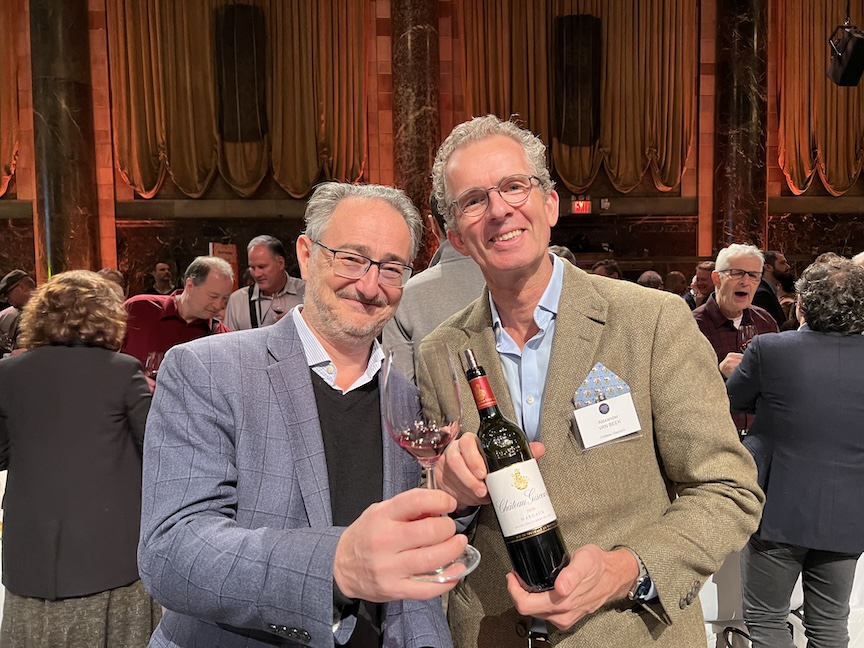
Château Giscours director Alexander Van Beek, right, at a tasting in New York, January 2023, with Bordeaux negociant Ivanhoe Johnston
This trajectory reached a symbolic milestone this year when Château Giscours 2022 was named Wine of the Year by Wine Spectator—a recognition that would have been less likely a generation ago. Today, Giscours no longer invites comparisons as a lesser alternative to its neighbors; it stands confidently on its own, a château that has rediscovered both its ambition and its place.
A bit of history
We can go back the future to explain why the recent emphasis on biodiversity is part of the plan not only to make the wine better, but also to accentuate the proud history of the estate, which traces its roots to 1552, when Bordeaux draper Pierre de Lhomme established the first vineyards. Over the centuries, owners such as Jean-Pierre Pescatore and Édouard Cruse transformed the château into a neoclassical palace, modernized winemaking, and commissioned the magnificent park designed by Eugène Bühler, a master landscaper from Versailles.
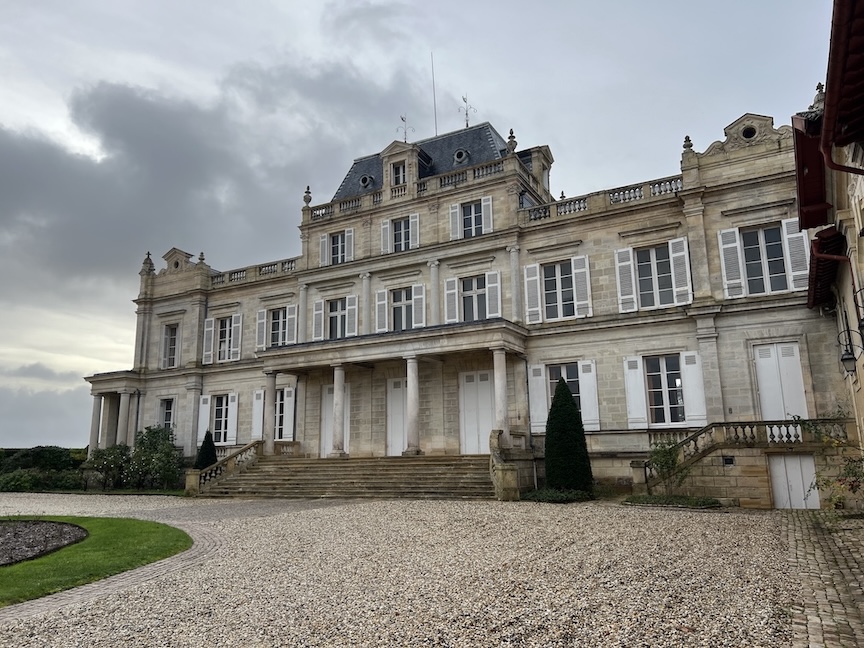
A gorgeous estate
Under the leadership of the Albada Jelgersma family, Giscours today continues its tradition of reinvention. The vegetable garden – tended daily by Ahmed Jaayjaa – supplies the château kitchen with seasonal produce. The herd maintains the fields. And in the cellar, a technical team oversees winemaking that blends precision with gentleness: optical sorting, cold macerations, intra-plot harvesting, and interplanting of old vines (some dating back to 1923). No less than 21 workers and their families live year-round on the estate, lending a sense of home to the place.
Magnificent holiday dinner
Stepping into the château that evening felt like entering a sumptuous holiday refuge. A tall Christmas tree stood beside long windows framed by golden curtains. Candles flickered at the edges of the room; historical paintings dominating the walls. The décor – warm, intimate, refined – reflected a philosophy of hospitality blending elegance with ease.
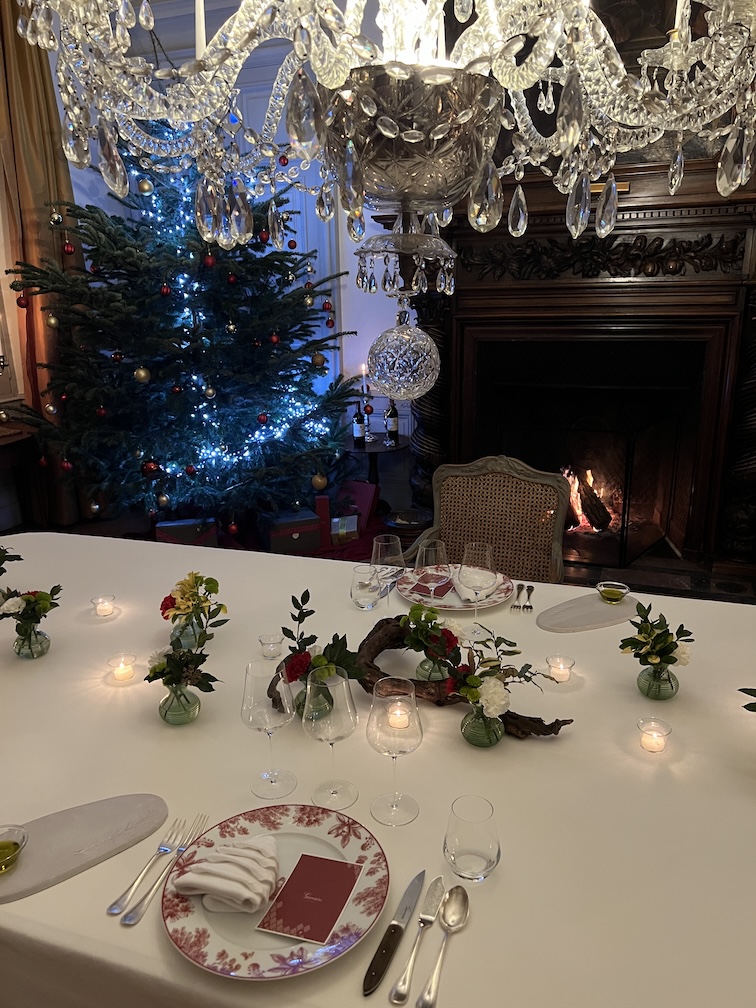
Fireside holiday dinner at Château Giscours
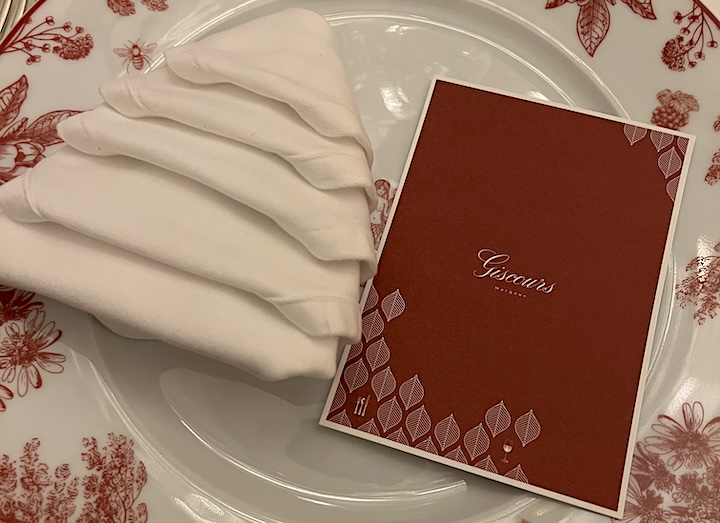
A table was set with red-and-white botanical porcelain. At its center lay the printed menu for Dîner du vendredi 5 décembre 2025. By the time dinner ended, I photographed my two hosts standing by the fireplace: Poisson on one side, and estate chef Benjamin Laurent on the other, wearing the château apron. The fire behind them cast a soft glow on the carved wood mantel, creating a tableau that could have belonged to another century.
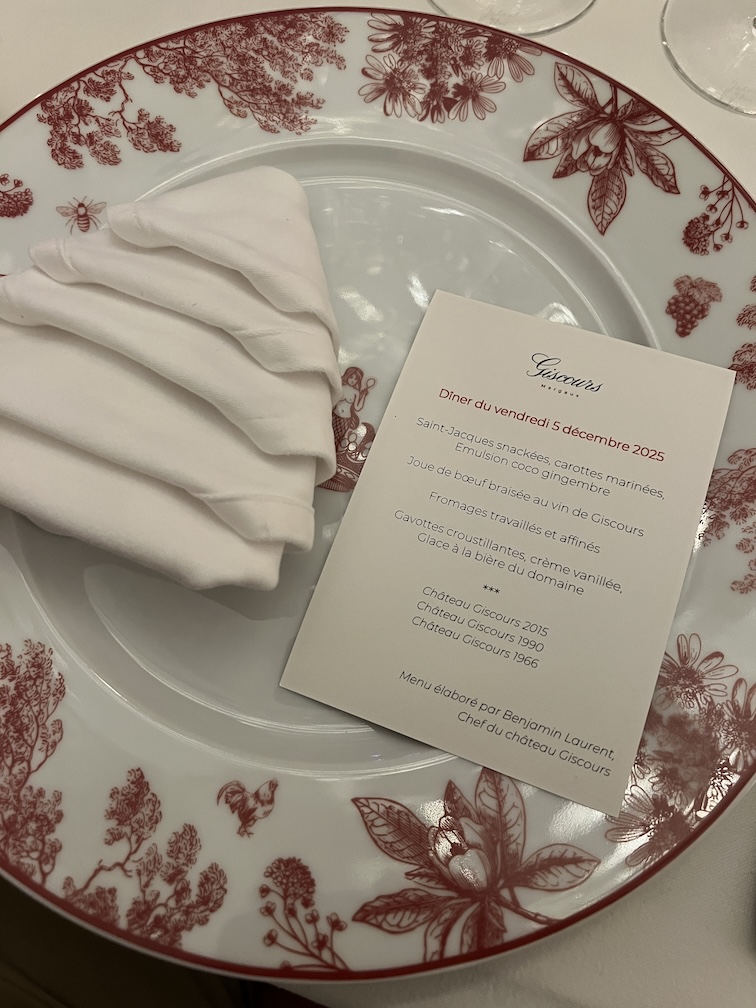
Attention to detail, the pristine table linen shaped as a Christmas tree.
Chef Laurent, who arrived at Giscours in 2019 after formative years with Michel Guérard at the amazing Les Prés d’Eugénie and as a pastry chef at the Hôtel de Crillon in Paris, prepared a meal that was a celebration of winter and of Giscours’s agricultural identity.

Chef Benjamin Laurent with estate manager Jérôme Poisson
He opened with an unexpected, deeply comforting dish that looked like a fine cappuccino but was chestnut broth, enriched with chopped chestnuts, foie gras, and a hint of Armagnac. Its aromas instantly set the tone: rich yet airy, nostalgic yet precise.
The next course showcased Laurent’s technical finesse: seared scallops whose caramelized crusts contrasted beautifully with carrots and grilled hazelnuts in an umami like sauce capped with delicate ginger-coconut emulsion that added lift. “I like having flavors that at once confront one another but also work together,” Laurent remarked after the meal. It worked.
No, that’s not cappuccino.
But it was the main dish – classic braised beef cheek in a Giscours wine sauce accompanied by silky potato purée – that best paired the Giscours wines that were served. It was a dish of depth, winter comfort, and classical balance.
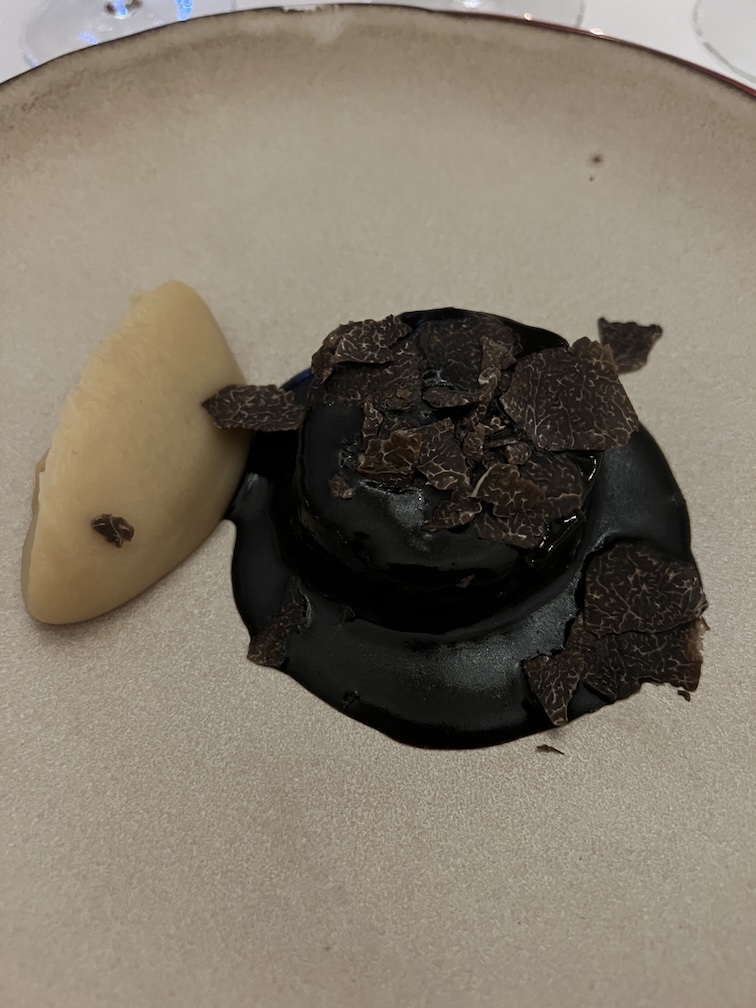
And that is not chocolate 🙂
And for the oldest Giscours, the 1966, I especially enjoyed the Brillat-Savarin with truffle in the cheese course, which included Vieux Gouda and fresh Chèvre de Touraine.
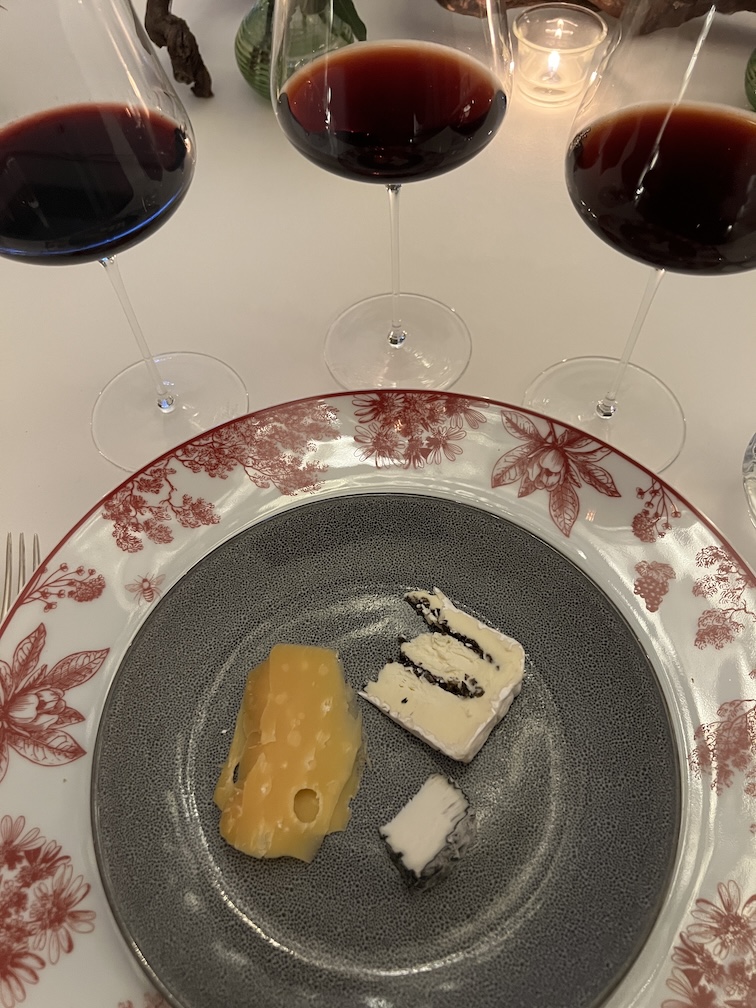
Cheese trio
The dessert delivered a playful surprise: crispy gavottes with vanilla cream and house-made beer ice cream, a nod to the chef’s pastry roots and the estate’s spirit of innovation.
Accompanying the meal were three vintages that illustrated the estate’s evolution across nearly fifty years: Check out my Instagram reel on this dinner!
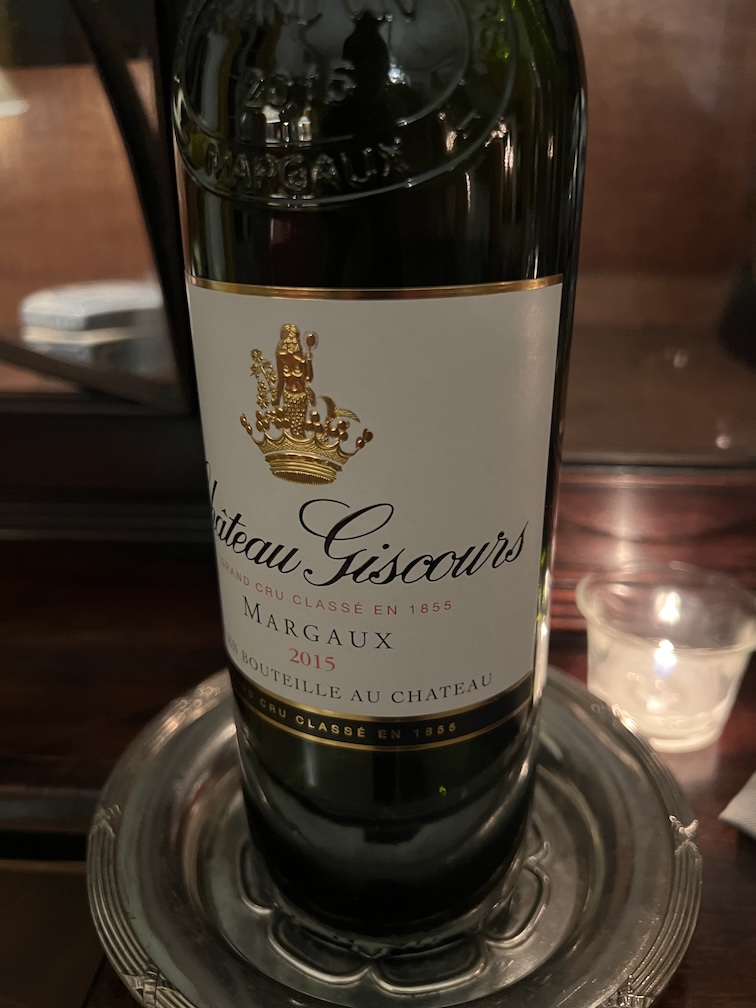
Brillant Margaux vintage, also excellent at Château Giscours
2015
A wine shimmering with a decade of youth, considered to be a great vintage for the Margaux appellation. Today, an adolescent with class, powerful yet polished, marked by suave tannins and a long, resonant finish. Still climbing toward its peak. Price on Wine-Searcher.
1990
More delicate, a touch thinned with age, the fruit softened. An instructive contrast rather than a standout, and perhaps the bottle/cork was not optimal.
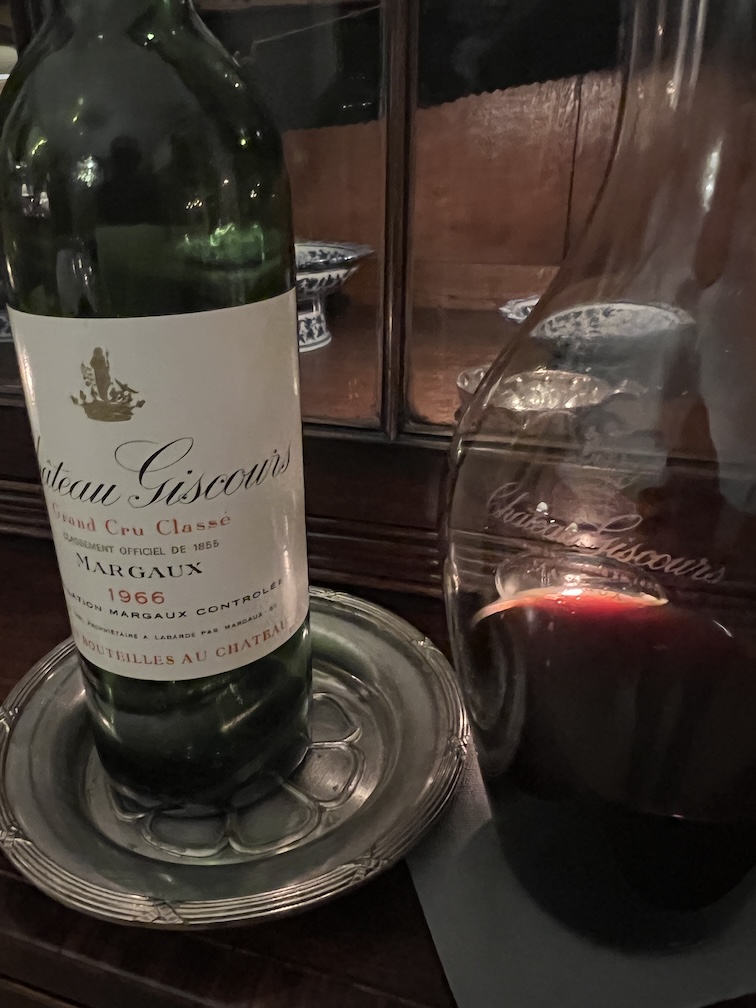
Birthday vintage
1966
The revelation of the evening. The aromatics unfurled with breathtaking vitality: truffle, forest floor, powdered cocoa, musk, all rising from the glass with coherence and grace. On the palate, it began firm, then opened gradually, becoming medium-bodied, expressive, and flavorful. A dryness on the finish, yet the wine remained vibrant, very much alive. Seeing the 1966 beside its decanter, the candlelight catching the garnet hue, felt like a communion with Bordeaux’s past.
Highs and lows
It is all about heights and valleys. In my many years visiting the Bordeaux region, I recall what Anthony Barton had told me back in 2002, when I was at Langoa Barton: each château has had its ups and downs. “In the 1920s for example, Léoville Poyferré was especially celebrated,” Barton said, “while we were not as well assessed.” Giscours may have had a bit of a valley from the mid-1980s to the 1990s, but the 1960s and 1970s proved superb. I still recall the 1970, a superlative wine drinking well still today, with a smoother palate than the 1966 for example.
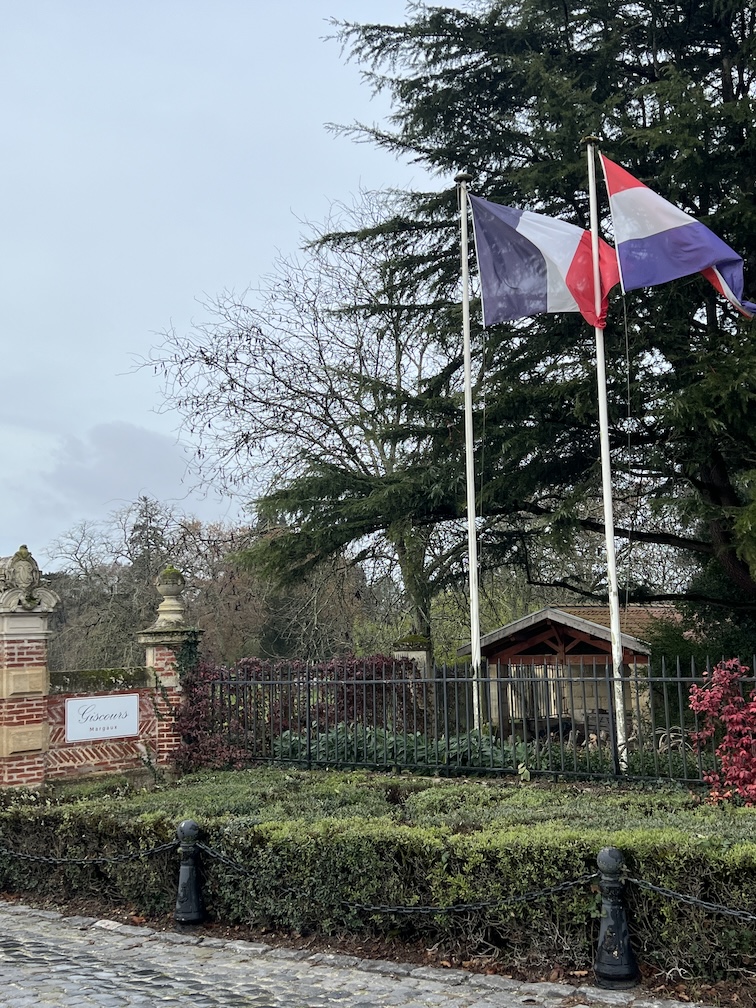
Flags of France and the Netherlands, reflecting Dutch ownership
I woke on my birthday to a quiet, misty estate. The ewes were grazing, a bit further from the château, as seen in the photo at the beginning of this text. I took a 20 minute walk, enjoying the fresh, pre-winter air. The night before had been more than a stay; it had been an immersion in a landscape shaped by centuries of human ambition and agricultural rhythm. Giscours is not frozen in time; it is alive, renewing itself with each season, each generation, each vintage. And savvy wine lovers should buy the wines. Before the dinner, I was impressed by the quality of the 2023 (Wine-Searcher price), a worthy follow up to the 2022 (Wine-Searcher price): despite recent tax increases, both affordable for the quality.
And one great way to find your favorite wines? Check out Capital One Shopping’s One Stop Wine Shop!
Share This