 Wine Chronicles
Revisiting Weingut Bernhard Huber
Malterdingen, Baden-Württemberg: Burgundy Precision, Baden Soul
By Panos Kakaviatos for Wine Chronicles
29 December 2025
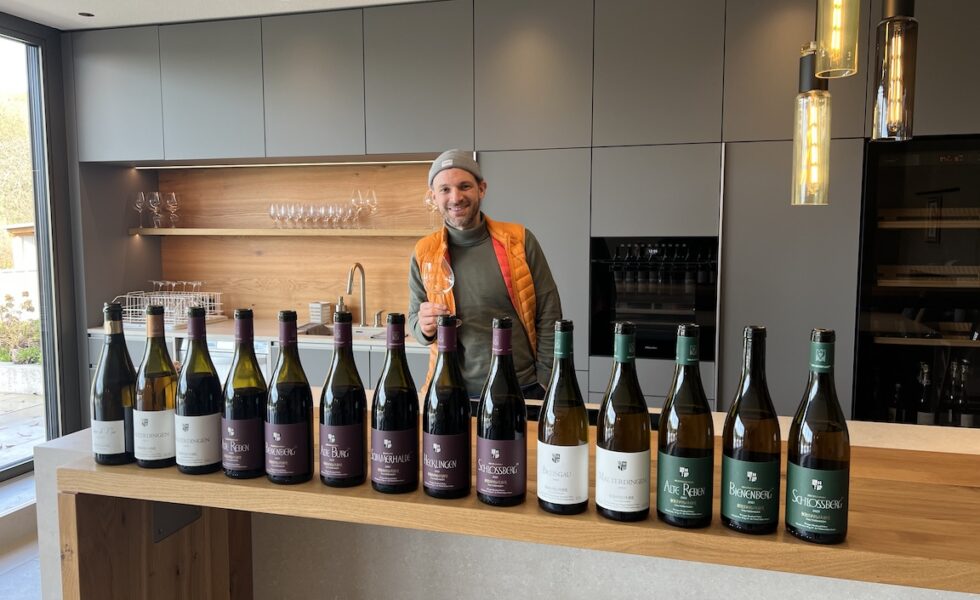
A visit to Weingut Bernhard Huber in Malterdingen is never just a tasting; it is a lesson in continuity, restraint, and conviction. I visited the estate on 11 November, in the calm that follows harvest – and a bank holiday in France. Julian Huber was not present that day, but a highly accomplished sommelier from the estate welcomed a friend and me, guiding us through an impressively broad and revealing lineup.
Few German wineries have shaped the modern understanding of Pinot Noir and Chardonnay as profoundly as Huber. Bernhard Huber was among the first to demonstrate that Germany could produce Pinot Noirs of genuine gravitas and longevity, not by chasing ripeness, but by embracing structure, restraint, and terroir. Bernhard’s frequent exchanges with Burgundy and his refusal to follow trends allowed him, already in the early 1990s, to craft wines that stood apart at a time when many sought power over precision.
When Julian Huber took over in 2014, aged just 24, expectations were daunting. A decade later, it is clear that he has not merely preserved his father’s legacy but sharpened it. Burgundy remains a reference point, but the wines today speak more clearly of Malterdingen, Bienenberg, Sommerhalde or Schlossberg than of any external model. The stylistic evolution is subtle but decisive: less overt oak, cooler fruit profiles, more reduction, and a striking sense of tension and salinity across both reds and whites.
The estate now harvests around 35 hectares, predominantly in Pinot Noir, rooted in weathered shell limestone soils that echo the Côte d’Or in their ability to confer finesse and longevity. Vineyard work is paramount, yields are modest, and sélection massale is used to refine the finest parcels. Grape variety has largely disappeared from labels: here, place matters more than nomenclature.
In the Glass: A Tasting Snapshot (11 November)
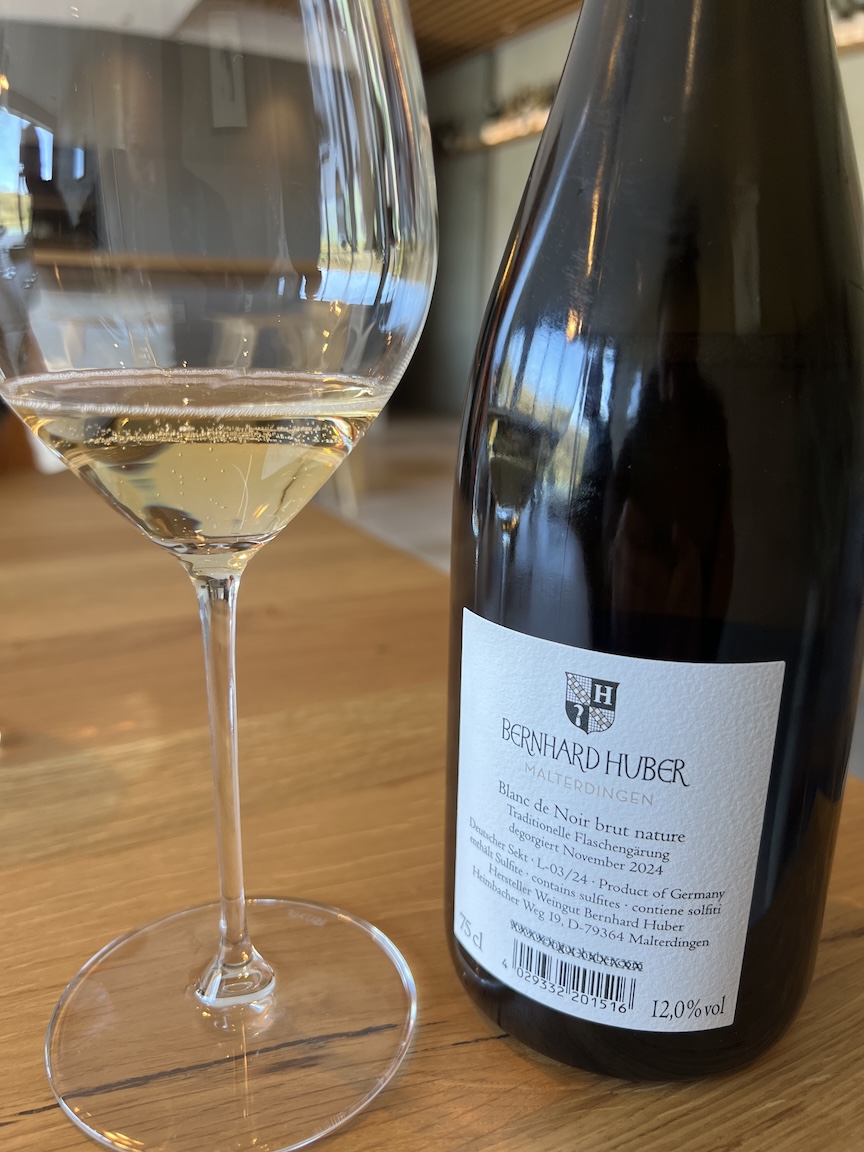
Excellent, traditional method bubbly
The tasting opened with their traditional method bubbly Blanc de Noirs, creamy yet precise, offering quiet depth rather than overt fruit. The dry rosé, produced since 2020 but pointedly without the word “rosé” on the label, underlined Huber’s philosophy: this is a terroir wine, smoky, reductive, and structured, aged 14 months in barrel with one-third new oak: decidedly not a casual summer pour.
We tasted through wines from the 2023 vintage, which, we learned, was warm and healthy overall, but punctuated by rain just before and during harvest. Larger berries and thinner skins brought mildew concerns, yet the finished wines show admirable clarity and balance rather than dilution.
Among the Pinots, the Malterdingen Ortswein (white label, red capsule) offered a classic, poised expression: fine red fruit, moderate alcohol (13%), and impressive depth for vines averaging 25 years. The step up to Alte Reben (red label) was immediate: older vines (around 45 years), lower yields, greater textural depth, spice, and tannic presence, still framed by Malterdingen’s signature finesse. Oak remains measured at one-third new, notably less than under Bernhard. The estate boasts many great growths, the equivalent of grands crus, designated in German as Grosses Gewächs or GG.

Whether a premier cru or GG level, distinctions sharpened. And I love the graphic design sense of the estate: white labels designate regions, while the red labels designate more premium level wines at village, premier cru or GG grand cru. Same for the whites, only labels for premium level wines are green.
-
The Bienenberg GG was beguiling yet reserved, with more acidity, limestone-driven structure, and a flirtatious nose that belied a tightly wound palate demanding cellar time.
-
The Köndringen, from younger Pinot Noir vines planted in 2018, was muscular and wind-swept, with spice, firm tannins, and a touch of bitterness.
-
The Sommerhalde GG on red clay and limestone near the Black Forest at 350 metres in elevation showed wonderful balance and poise, though extraction here requires a careful hand.
-
The Hecklingen, tasted from its very first vintage in 2023, felt frank but still finding its voice: tighter and more astringent than Alte Reben at the same price point.
Then came the standout: the Schlossberg GG. From an extraordinarily steep, wind-exposed slope, yields of just 25 hl/ha and production of roughly 1,500 bottles, this was a wine of rare harmony. It was airy yet substantial, with bright red cherry fruit wrapped in limestone freshness, tannins present but already spherical. A wine that feels both light and profound, and unmistakably complete.
The Whites: Quiet Authority
Chardonnay has been part of the Huber story since the late 1990s, and today it sits firmly among Germany’s benchmarks. The Malterdingen Chardonnay—direct pressed, unfiltered, minimal bâtonnage—was saline, mineral, linear yet generous, already sold out at the time of my visit. The Alte Reben Chardonnay in a gorgeous green label followed with Meursault-like breadth: buttery but precise, long, and quietly powerful (12.5%). Julian’s affection for Burgundy is no secret. His dog is named Perry, after Meursault’s Perrières.
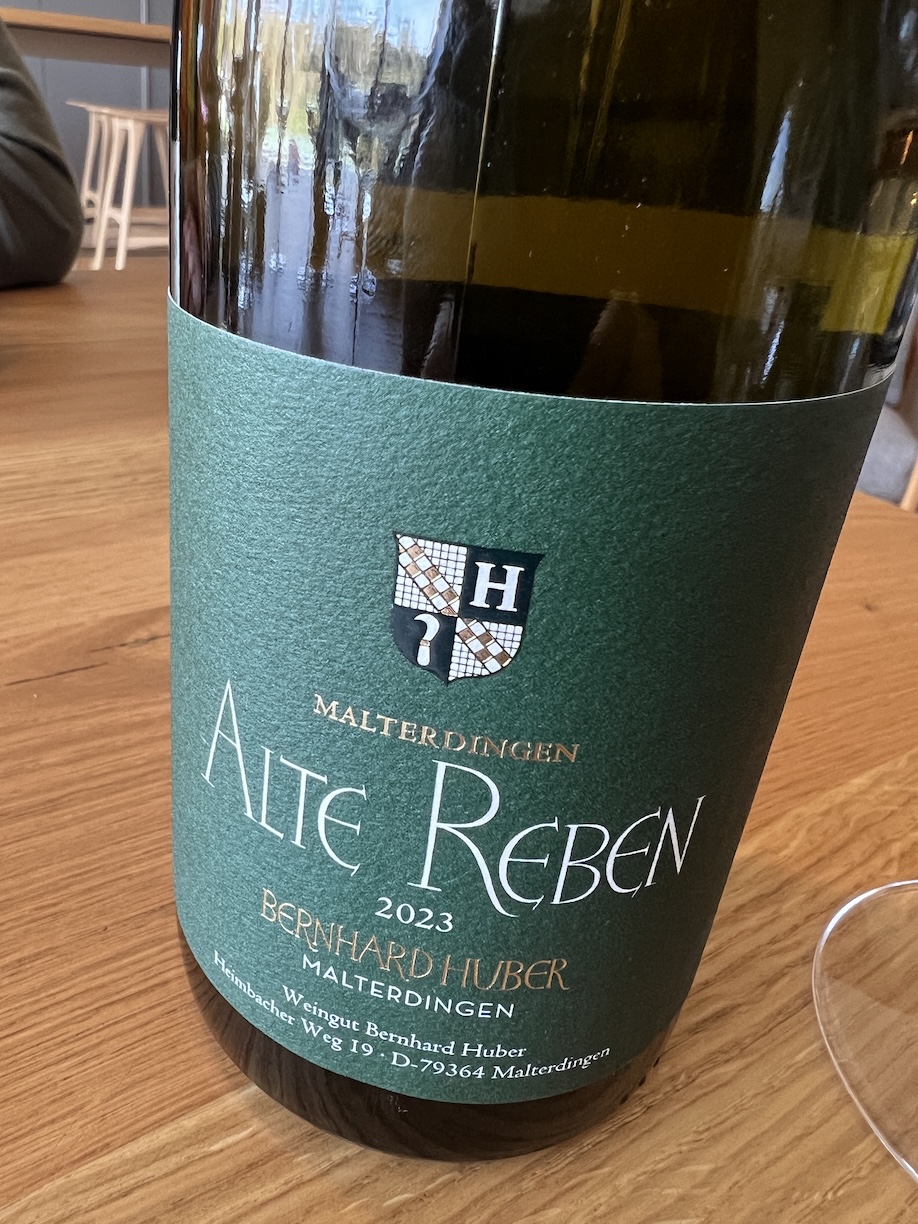
For optimal price/quality ratios, the Alte Reben (old vines) in both Chardonnay and Pinot Noir, is an excellent choice!
At the top, Bienenberg GG Chardonnay showed greater reduction and acidity, white florals and chamomile, while Schlossberg GG Chardonnay took everything (yet again) a step further: crystalline, herbal, intensely saline, with remarkable length and composure. These are wines built not for immediate charm but for evolution.
A brief aside worth noting: the Breisgau cuvée (50% Pinot Blanc, 50% Pinot Gris), now in its third vintage, displayed what sommeliers aptly call the “Huber nose”—reductive, precise, and disciplined. Pinot Gris is picked early to avoid heaviness, resulting in a taut, gastronomic white of real interest.
A World-Class Estate, Quietly So
This was not my first encounter with the Huber estate. I first visited Wildenstein in 2014, walking the limestone-over-clay slopes with Bernhard Huber himself, just months before his passing. As I wrote at the time, one cannot help but notice the rocky surface and pronounced incline of this extraordinary site—a place that feels closer to Burgundy than to most preconceived notions of German red wine. Bernhard reminded me then that it was Cistercian monks who first planted Pinot Noir here, centuries earlier, laying the foundations for what would become one of Germany’s most revered vineyards. Wildenstein, just two hectares in size, was already widely regarded as producing arguably the finest Pinot Noir in the country, irrespective of price.
Historical records dating back to 1285 attest to Pinot Noir plantings known as “Malterdinger”, named after the village that remains the heart of the estate today. The continuity is striking. The vineyards have been in the Huber family for generations, but it was Bernhard and his wife Barbara, upon taking over in 1987, who began estate bottling under their own name. Until then, grapes and wine had been sold to a local cooperative. That decision—to bottle, to define a style, to look to Burgundy not for imitation but for inspiration—changed the trajectory not only of the estate, but of German Pinot Noir more broadly.
That 2014 visit remains vivid in my memory. Bernhard was generous with his time, walking me through the vineyards and later insisting we sit down for lunch, to taste the wines in their proper setting, as he put it—at table, with food, and without haste. Returning now, a decade later, tasting through the range under Julian’s stewardship, the sense of continuity is unmistakable. The wines have evolved, sharpened, and gained tension, but the foundations laid by Bernhard with patience, humility before terroir, and an unshakeable belief in Pinot Noir, remain firmly intact.
Around 90% of Huber’s production remains in Germany, and it is hard to find! Most wines at the estate were already sold out. Some are exported, particularly to Scandinavia, a market that is growing steadily. Demand far exceeds supply, especially for the Chardonnays and GGs, yet the estate resists hype. What defines Huber today is not ambition for expansion, but an unwavering commitment to style.
As Julian Huber has said, wines here are not meant to impress instantly, but to reveal themselves over time. Tasting across the range in November, that philosophy felt not like dogma, but lived experience. These are wines of discipline, restraint, and inner confidence: Burgundian in method, unmistakably Baden in soul.
Few estates pursue their vision with such consistency. Even fewer succeed so completely.
Share This