 Wine Chronicles
Margaux, Latour, Trotanoy and so much more
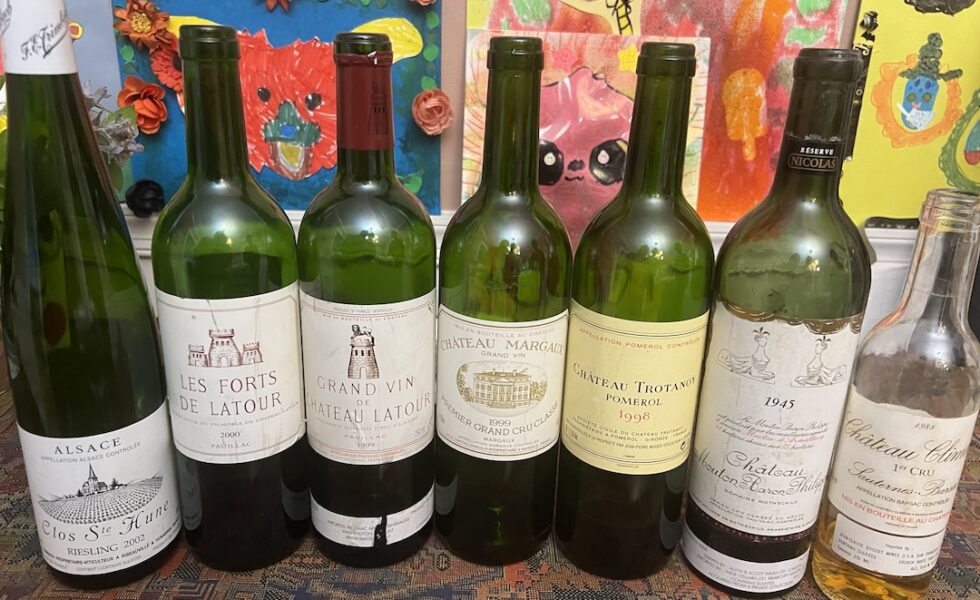
New Year Wine Dinner with Friends
By Panos Kakaviatos for Wine Chronicles
5 January 2026
Thanks to Tamar and Keith Levenberg for hosting an excellent dinner with Maureen Nelson, Joel Davidson and myself. I had not seen Maureen in ages, so it was especially great to see her: You haven’t changed one bit, Maureen! Each of us brought some fine wines to share.
We opened mostly Bordeaux. Since I am in Alsace, I also brought a Domaine Trimbach Clos Sainte Hune Riesling 2002 (96) to start things. I had purchased it from the winery upon release. It had a dark straw color, but never you mind: not a hint of oxidation. Although a bit musty upon opening, normal after being cooped up in a bottle for nearly 23 years, that blew off after I double decanted. Double decant a dry white, you may be asking? That can be useful, I say!
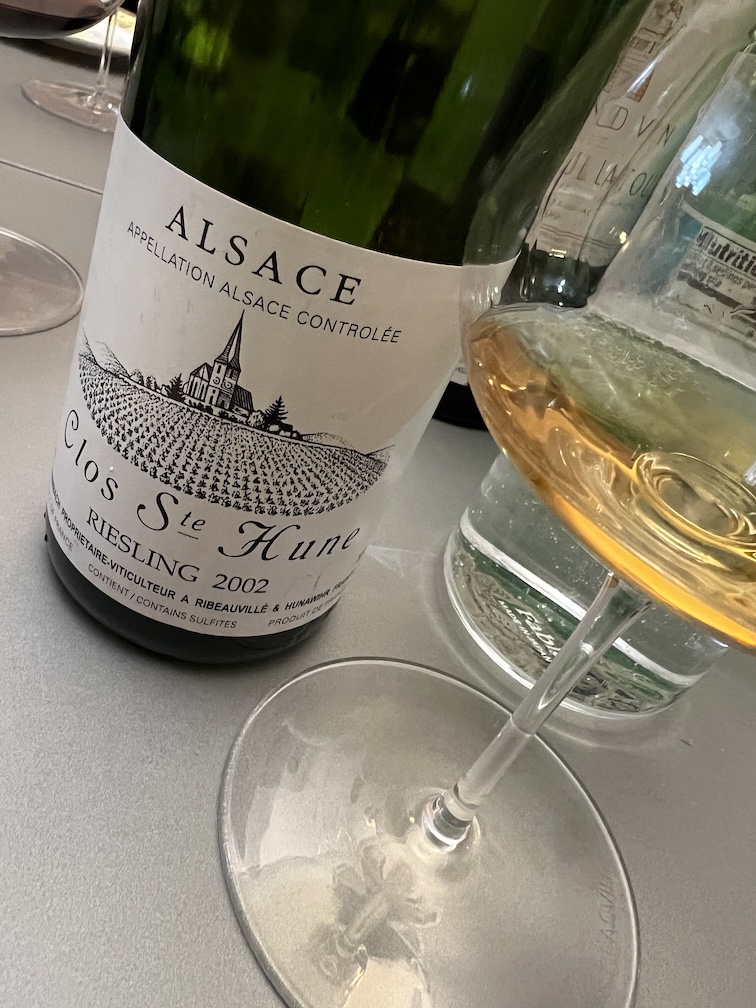
Properly aged Riesling, double decanted 😉
A somewhat soft spoken Riesling, as Clos Sainte Hune can pack more power. Medium bodied, but it builds, beckoning further drinking. The balance between 4.2 grams per liter of residual sugar and 9 grams of total acidity left a dry impression, with lemon peel, white stone fruit, and hints of wet earth but not “old” tasting. That last aspect merely added complexity to the picture. Over three hours later, for the cheese course, we returned to the wine, which was not put on ice or in the fridge, and I dare say that it improved with respect to freshness and vibrancy. The palate felt suave and smooth. A long, albeit subtle finish. Not powerful or intense, but subtle. A friend tells me that he refuses to serve quality Riesling unless at least 21 years old, and this 23-year-old wine proved his point. The estate dubs 2002 as an “outstanding vintage, especially for Riesling”. The alcohol clocks in at 13%.
Clos Sainte Hune has 1.67 hectares under vine on stony argilo-calcaire, or Muschelkalk, limestone terroir, exclusively planted in Riesling, and located in the heart of Grand Cru Rosacker, in Hunawihr. The limestone soil allows this Riesling to develop a specific aroma and a wonderful concentration of fruits. Dry yet succulent, of phenomenal complexity, this wine develops an extraordinary aftertaste of wet stone after a few years in bottle. The plot, which is approximately 50 to 70 years old, is south south east exposed and the yields are low. Annual production reaches about 9,000 bottles, depending on the vintage.
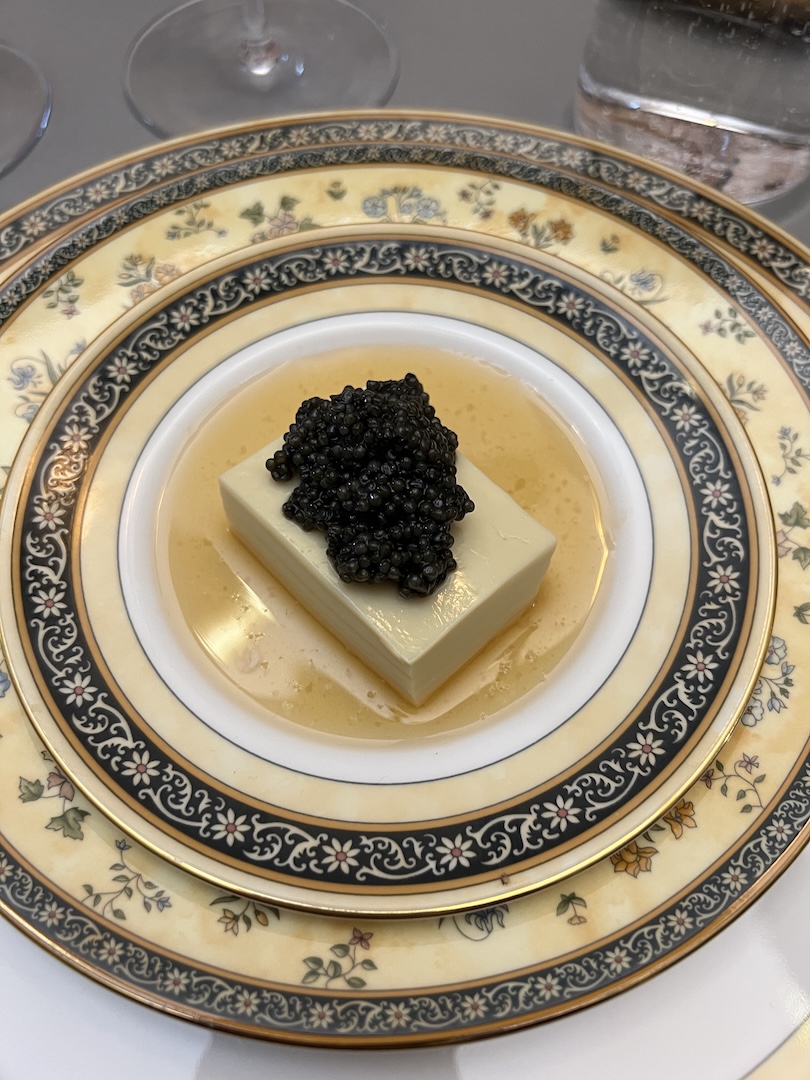
As tasty as it looks: Bravo Keith!
Thanks to our wonderful hosts for superb salami and foie gras, French bread, and caviar atop Tamago tofu, also known as egg tofu, which is a popular Japanese custard made from eggs and dashi (Japanese soup stock), not soybeans. Its name comes from the smooth, silken texture and square shape, which resembles traditional tofu. All of the above went especially well with the Clos Sainte Hune.
Thanks to Maureen Nelson, we kicked off with an excellent Les Forts de Latour 2000 (94), the second wine of Château Latour. What struck me was the youthful blueberry cool fruit and cassis, delivered smooth. A pristine expression not too tertiary but with hints of cigar box and plenty of plum like richness and excellent integration of the new oak. Shortly after release, the celebrated critic Robert Parker said that this second wine would evolve for about 15 years, but it is firmly in a pleasing drinking window at about 25 years in bottle, no doubt (at all) due to the unhurried ripening period of the 2000 vintage, plus an Indian summer that led to optimal harvest conditions, reflecting balance and poise.
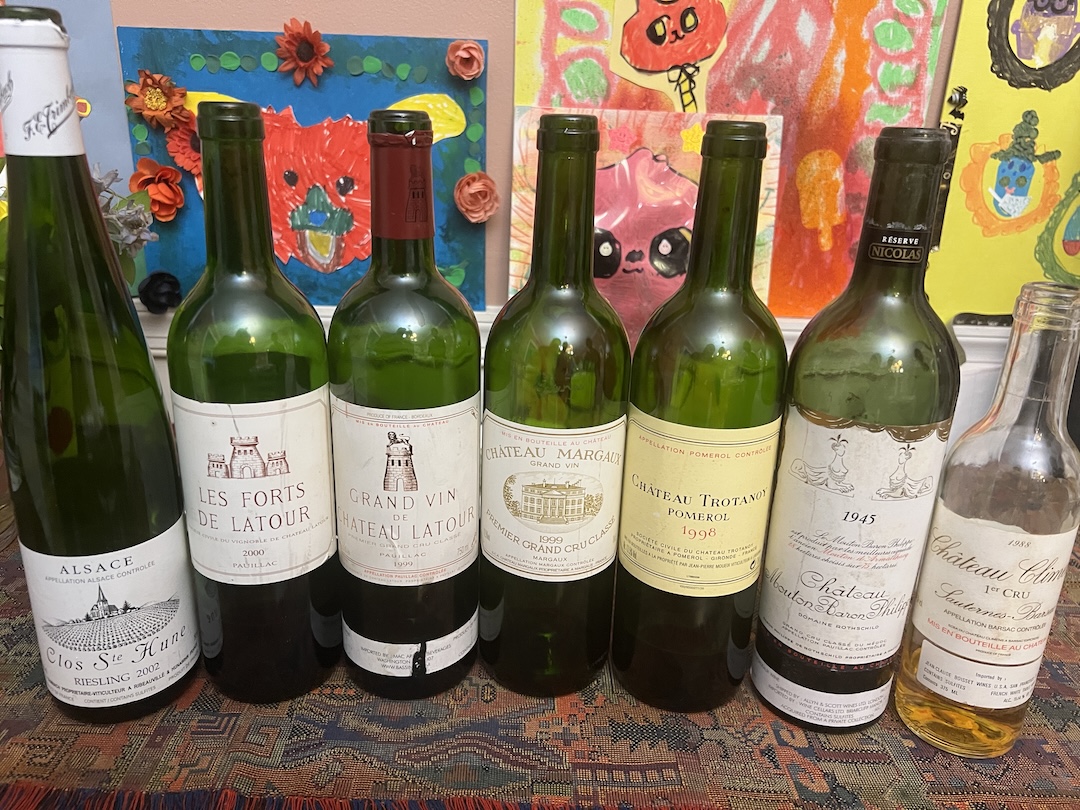
Les Forts 2000 performed very well in this lineup!
Did you know that the wine was first labelled with this name in 1966? Grapes come from the edge of the famous Enclos at Latour and from plots located outside the Enclos, in Cru Classé areas of Pauillac such as Piñada, Petit Batailley and St. Anne, which have belonged to the estate for more than a century and whose vines benefit from a high average age (around 40 years). Furthermore some plots that could be used in the Grand Vin may finally be included in the Forts de Latour blend, depending on how their quality is judged during the blending tastings. Les Forts de Latour is produced with the same care as the Château Latour, both in the vineyard and in the winery. One main difference, apart from grape origin, is a lower proportion of new barrels – between 50 to 60% – for aging. The blend for Forts de Latour also varies from one year to the next, but there is almost always a higher proportion of Merlot (25 to 30%) compared to the Grand Vin. Not sure about the exact blend for the 2000.
Latour and Margaux: 1999
We then tried the Château Latour 1999 (93), which I had purchased shortly after release, from a French merchant. It is interesting to note that Robert Parker dubbed the 1999 Latour “exceptional” for the vintage, a “modern day version of Latour’s magnificent 1962 or 1971” when he tasted the wine from barrel. Just over 25 years later, what’s the verdict? I had double decanted the wine four hours before it was served over Keith’s amazingly delicious filet mignon of elk (accompanied by equally fabulous and silky smooth purée de pommes de terre and haricots).
It is a good idea to aerate a wine of 25 years, to allow for any stuffy aromas to dissipate, and they did. The wine revealed quite a lot of fruit but also high-toned acidity that left its mark, in contrast to the more supple and richer Les Forts from the superior 2000 vintage. Over time, the 1999 exhibited floral and fresh meadow tertiary notes, as well as the telltale Pauillac graphite. While the 2000 showed fuller body and superior richness, I grew to enjoy the linearity of the 1999 Grand Vin. It had a longer finish, its inherent tension matching the richness of the elk nicely, but was not quite as good as the Forts de Latour from the 2000 vintage.

Which one was better?
About 1999
Why the 1999? Joel brought the Château Margaux 1999, so I thought it would be fun to compare the two First Growths from that vintage. While 2000 is seen as an exceptional vintage, especially in the Médoc, 1999 proved more challenging, taking a clear back seat to the 2000 due to unpredictable growing conditions: In August 1999, the outlook was reasonable despite a hurricane early in the season and wet weather late in the Spring. Then rain storms hit with a vengeance. Because we also enjoyed the Château Margaux 1999, I tried to look up precise station rain totals for Margaux vs. Pauillac in 1999, but they aren’t easily available online. I think that terroir differences support the idea that Margaux “withstood” the heavy late season rainfall better than Pauillac/Latour. So even if actual rain totals weren’t wildly different between the northern and southern Médoc in 1999, Margaux soils likely coped better with late showers, potentially preserving sugar accumulation and limiting dilution effects compared to Pauillac/Latour. Indeed, Château Latour displays deep, dense layers of coarse gravel on a subsoil of clay and marl while Château Margaux shows thinner, more superficial and finer gravel mixed with varying amounts of sand, limestone, chalk, and clay.
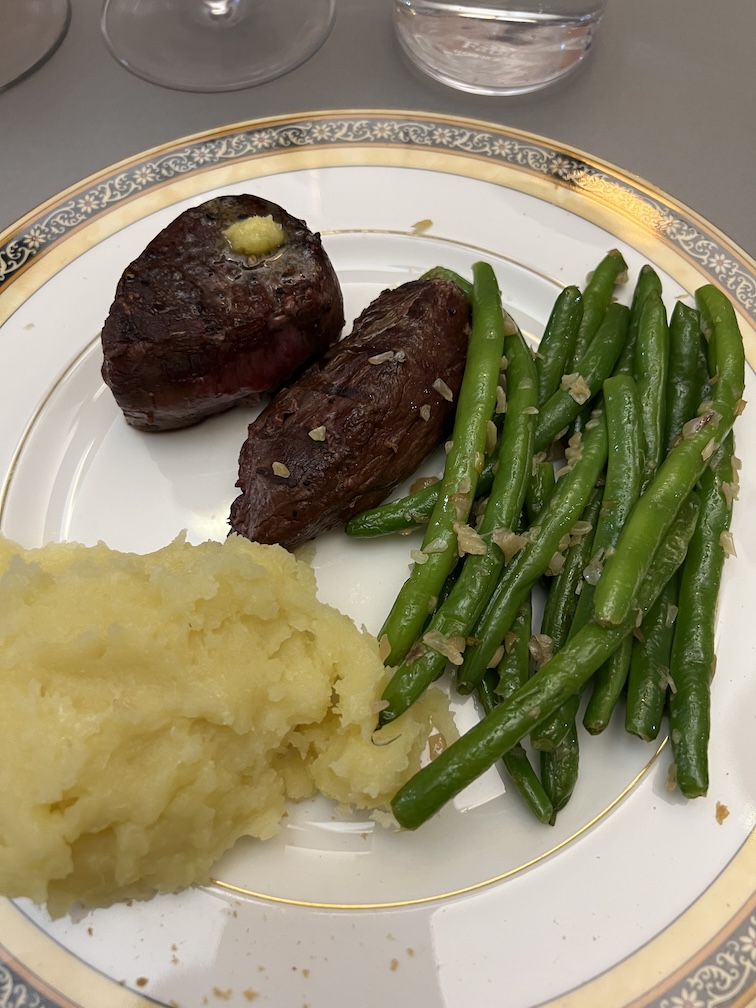
Filet mignon of elf, from the barbecue and topped with truffle butter, paired with oh so silky smooth purée de pomme de terre and savory green beans.
Château Margaux 1999 (96) – I recall first encountering this wine at the château with fellow wine aficionado Frédéric Lot, after it had just been bottled, back in 2001 during a visit to the estate, along with 1997, 1998 and 2000 – then a barrel sample. While the 2000 showed the most promise back then, the 1999 was my second favorite, followed by the (then) more charming 1997 and finally the (then) rather closed 1998. More recently, some seven years ago, over a vertical at Taberna Del Alabardero in Washington D.C., I rated it 94 as yielding a fresh bouquet of spring flowers and bergamot tea along with a touch of wet earth, the palate (then) lovely in its elegance, easy to drink, even though lacking the backbone of the 1996, which had been tasted alongside.
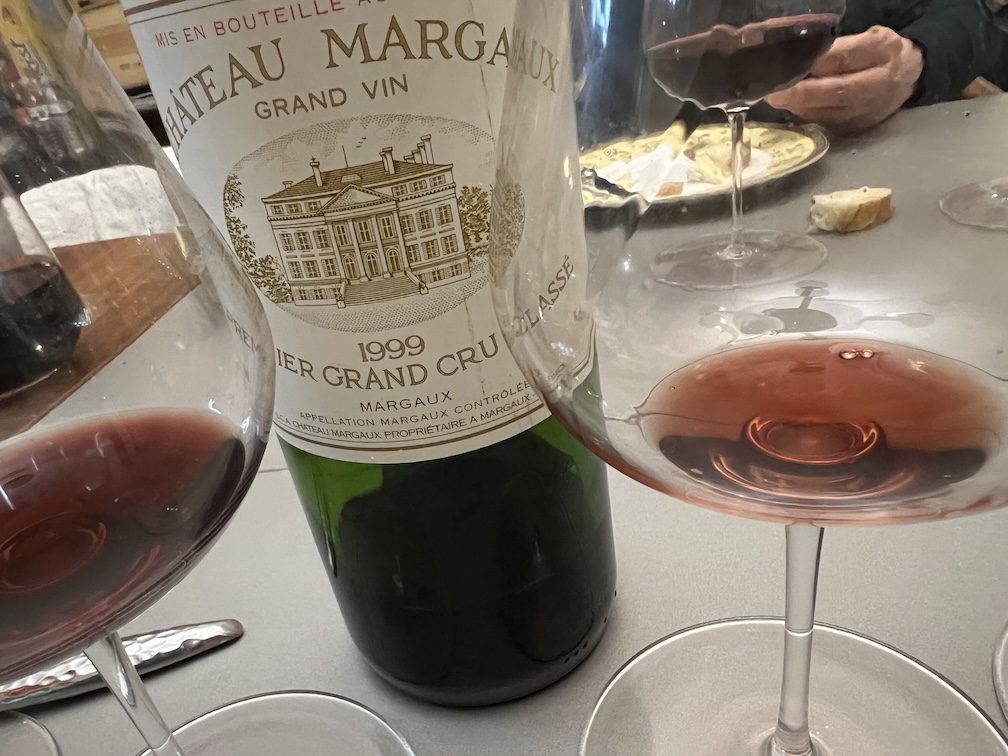
Oui, c’est magnifique ce Margaux 1999
But chez Keith and Tamar, the wine had just been popped and poured, unlike the double-decanted Latour 1999. From the start, it displayed impressive palate depth, more so than the Latour 1999, which was medium-bodied compared to Margaux’s more full bodied aspect. The Margaux also displayed better focused red and black berry fruit, furthermore leading to wonderful crushed mint and tobacco expressions on the long finish. In a review from 2022, William Kelly compared it to the 1985 vintage, and that is quite a compliment. I can see why. I really liked the 1999 Margaux this time.
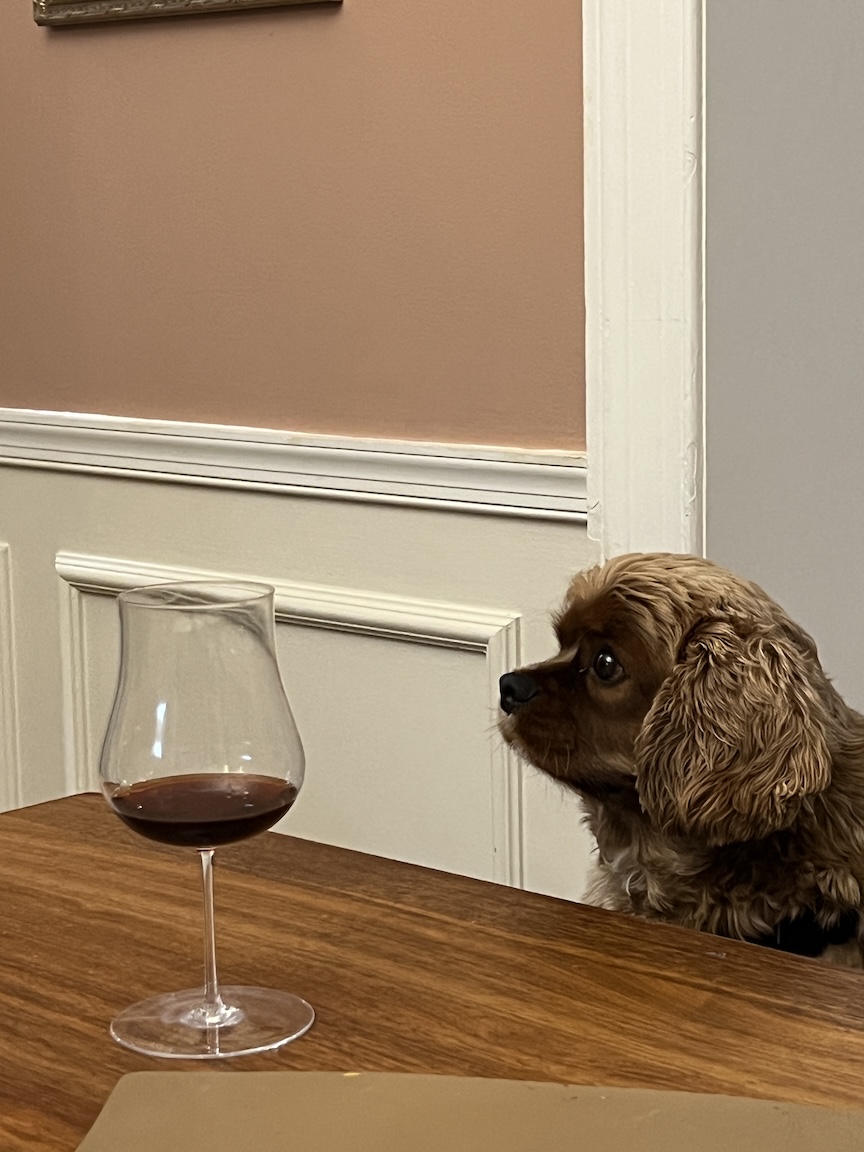
Ozzy, the most discerning among us
Château Trotanoy 1998 (97) – Thanks to Keith, this majestic wine also was served, and I immediately loved it, also as a superlative pairing to the elk filet. Trotanoy can be like Léoville Las Cases: it can take a long time to open up, but by Golly in January 2026, the wine sang. It stole the red wine show with mellowed power, sophisticated richness and suave tannin and fine dark chocolate notes along with Médoc-like graphite. A wine of layered polish, not gloss. With time in glass, it only improved. And consider just how good 1998 was for Merlot-dominant wines in Pomerol: powerful, concentrated, tannic, and long-lived reds with rich dark fruit and spice. After nearly 27 years in bottle, Trotanoy has entered an early drinking window. Yes, early! Many critics say that 1998 counts as one of the greatest Right Bank vintages ever. It is most certainly a benchmark vintage.
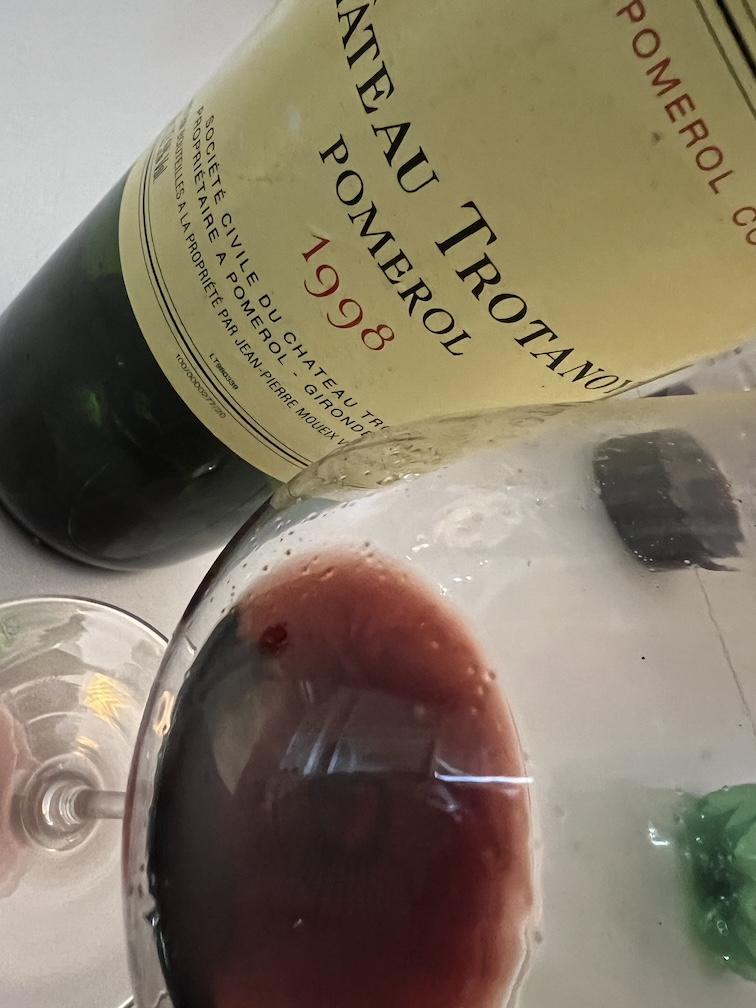
Fabulous, with upside potential !
Jean-Pierre Moueix purchased the estate in 1953, but Château Trotanoy has been considered one of the premier crus of Pomerol since the end of the 18th century. The soil of Château Trotanoy is a combination of gravel and very dense clay which tends to solidify as it dries out after rain to an almost concrete-like hardness, hence the name “Trotanoy,” which can mean “too wearisome” in French. The Trotanoy vineyard slopes gently to the west. The soil at the highest point of exposure contains a good proportion of gravel, becoming progressively more dominated by clay as the elevation declines.
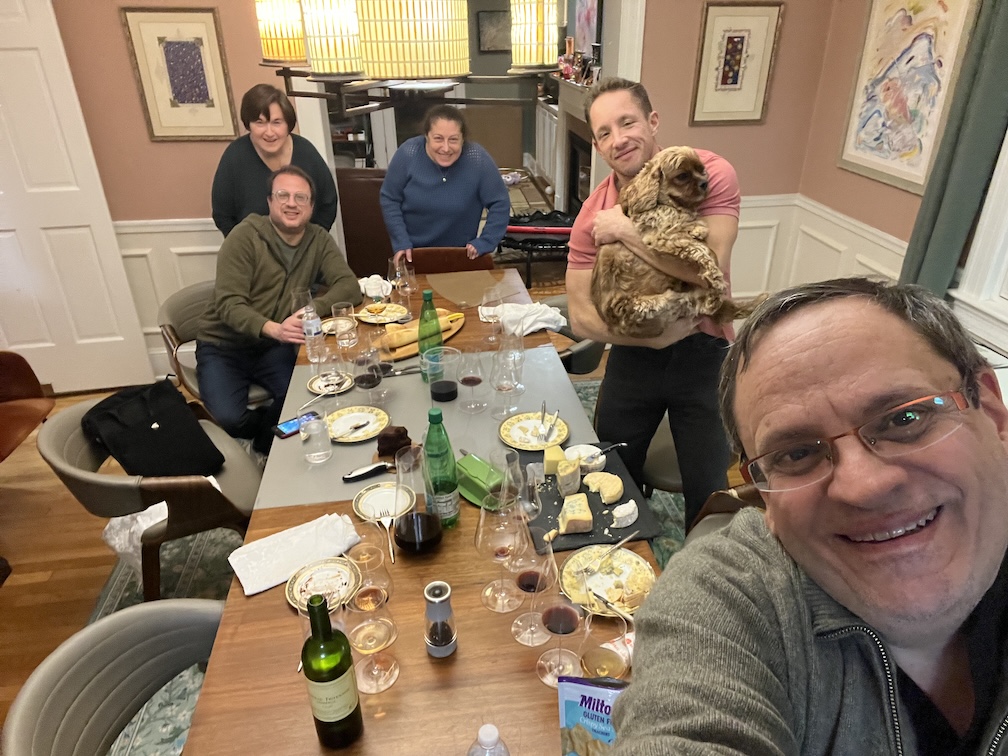
Happy crew ringing in 2026 with great food and wine!
Under this clay is a subsoil of red gravel and an impermeable layer of hard, iron-rich soil known as crasse de fer. This soil diversity brings power, depth and complexity to the wine. Trotanoy is vinified in small concrete vats, while aging takes place in oak barrels, about 50% new oak. Trotanoy is a naturally profound, complex, richly-concentrated wine with outstanding aging potential, proven in this 1998. The wine possesses a deep color and a dense, powerful nose, repeated on the palate with the addition of creamy, dark chocolate notes, and a singular concentration of flavor owed to its very old vines.

A final red, vintage 1945
Keith and I have been trying to source a bottle of Château Mouton Rothschild 1945 and share the cost among several wine pals, but it is evidently not an easy task. And what happens when one purchases such an old bottle and then encounters a cork or other problem? Keith sourced a Baron Philippe wine from the 1945 vintage, coming from, as the label indicates, the best vines of the former Mouton d’Armailhac vineyards. Much of the vines used to craft the bottle that Keith opened for us – the Château Mouton Baron Philippe 1945 vintage – would later be used for what has come to be known today as Château d’Armailhac. Upon opening I was struck by almost salty taffy aromas, not unappealing, and actually quite intriguing. The palate was more aggressive in nature and quite acidic. The wine, alas, was past due, as can happen with such old bottles. But kudos to Keith for bringing this to the table, as the label is gorgeous!
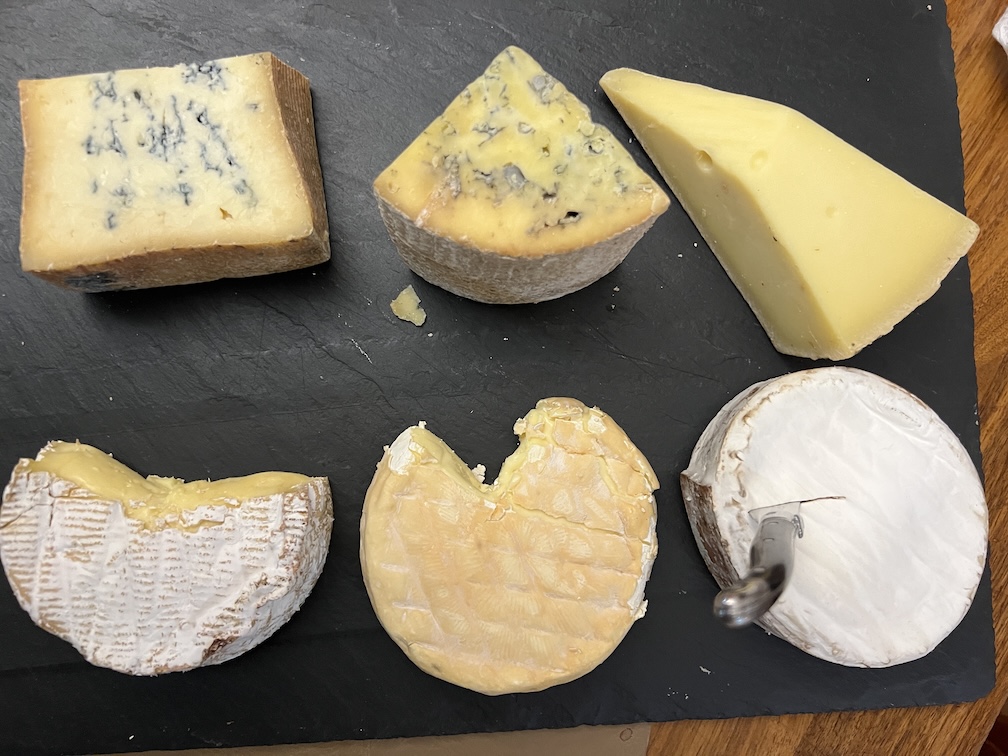
Wonderful cheese plate!
Château Climens Barsac 1988 (97) – For the superb assortment of cheeses, we enjoyed both the Clos Sainte Hune but also – especially with the blue type cheeses – the exceptional Climens from Barsac. I have always loved this wine, and thanks to Maureen for the half bottle, which did not disappoint. Time in glass yielded vivid notes of candied orange peel, crème brûlée, black tea and subtle ginger from the botrytis (noble rot).
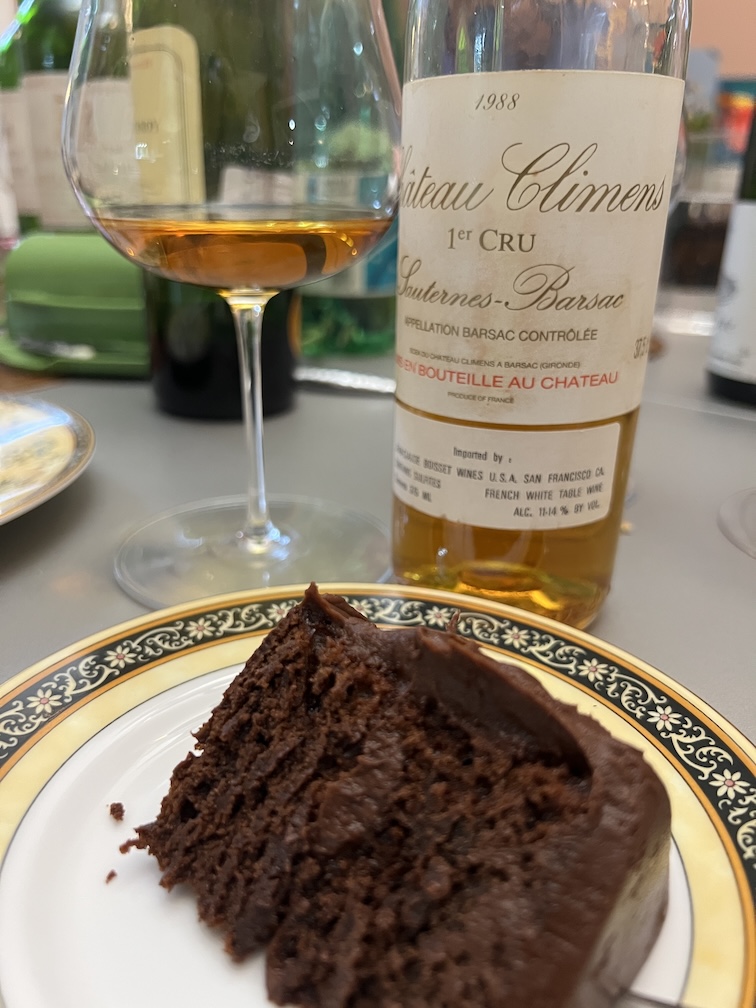
Great combo!
The 1988 vintage in Barsac (and Sauternes) was outstanding, considered one of the best of the late 1980s, marked by excellent noble rot developing later in October after a warm and dry September, leading to rich, honeyed, and complex sweet wines with great acidity and aging potential. Château Climens along with Coutet produced great wines from Barsac in that vintage, still vibrant today, as proven over this dinner. And thanks to Keith and Tamara for the intensely delicious chocolate cake, which also paired well with the Barsac.
All in all, a great evening!
Share This